1.Malaysian Pod System E-Cigarette Regulation
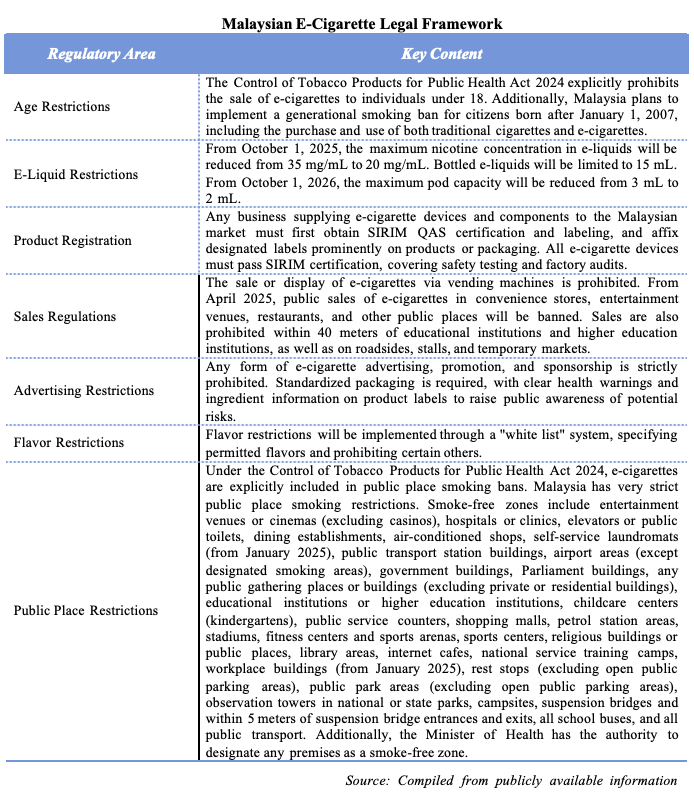
1.1、Malaysian E-Cigarette Legal Framework
For a considerable period, e-cigarettes in Malaysia operated in a largely unregulated environment. In March 2022, the Ministry of Domestic Trade and Consumer Affairs issued an administrative order, the Trade Descriptions (Certification and Marking of Electronic Cigarettes) Order 2022, requiring all locally manufactured or imported e-cigarette products to obtain SIRIM certification and labeling, administered by the Ministry of Domestic Trade and Consumer Affairs. In 2023, the Malaysian government amended the Poisons Act, exempting nicotine in e-liquids from the Act's prohibitions, thereby legalizing the sale of nicotine-containing e-cigarette products. In 2024, the Control of Tobacco Products for Public Health Act 2024 came into effect, formally bringing e-cigarettes under the scope of tobacco product regulation, with provisions governing product registration, sales, packaging, labeling, and smoke-free areas.
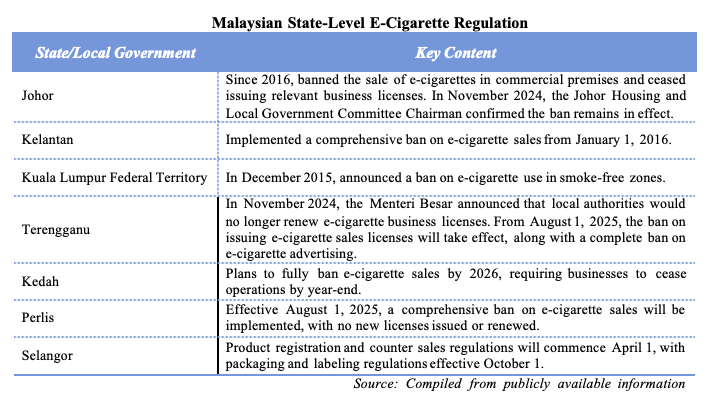
1.2、Malaysian State-Level E-Cigarette Regulation
In addition to federal regulations, Malaysian states have the authority to impose stricter e-cigarette regulations. Johor and Kelantan had already introduced restrictions before the federal law came into effect.
1.3、Malaysian E-Cigarette Tax Policy
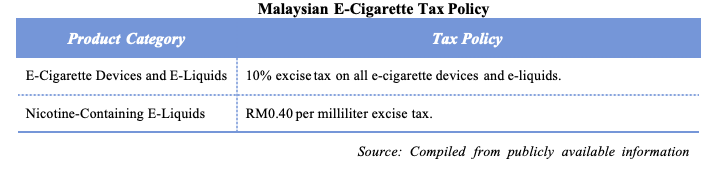
From January 1, 2021, Malaysia imposed an excise tax on e-cigarettes and their components. Under the Finance Act 2020, all e-cigarette devices and e-liquids (including both nicotine-containing and nicotine-free e-liquids) are subject to a 10% excise tax. In 2022, the Ministry of Finance announced the Excise Duty (Amendment) Order 2023, imposing a RM0.40 per milliliter excise tax on nicotine-containing e-liquids or gels effective May 1, 2023.
2.Current Status of the Malaysian E-Cigarette Market
2.1、Malaysian E-Cigarette Market Sales Scale
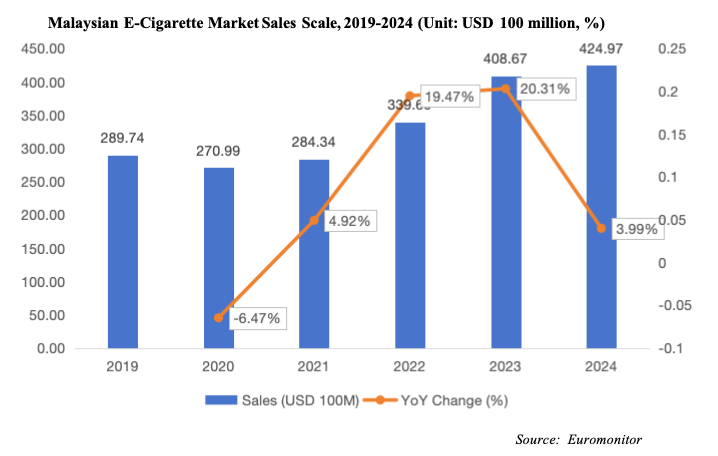
From 2019 to 2024, the Malaysian e-cigarette market showed overall growth, with rapid expansion during 2022–2023 driven primarily by disposable e-cigarettes. Low prices, high nicotine content, and diverse flavors enabled disposables to rapidly capture market share and drive overall market growth. During the early pandemic and the 2020 policy vacuum period, offline channels were restricted, temporarily slowing market growth. In 2024, growth slowed significantly as tax policies and regulatory uncertainty became key dampening factors. The introduction of excise taxes suppressed demand among price-sensitive groups, while regulatory uncertainty further weakened growth momentum. Overall, after weathering the pandemic shock, the disposable boom, and policy-driven stimulus, the Malaysian e-cigarette market now faces dual challenges from taxation and regulation. Future growth will be increasingly influenced by policy factors, potentially entering a period of low-speed growth.
2.2、Malaysian E-Cigarette Market Segment Structure
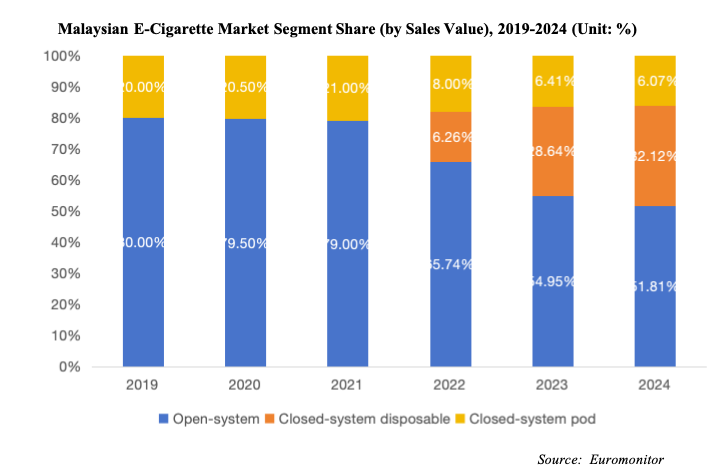
From 2019 to 2024, the Malaysian e-cigarette market structure shifted from open-system dominance to a dual-track structure of "open systems + disposables." In 2024, while open systems still held over 50% share, they continued to contract under pressure from disposables' low prices, convenience, and flavor advantages. Disposables grew from zero to 32% market share during 2019–2024. Pod systems continued to be marginalized due to price disadvantages and technology gaps. This evolution essentially reflects consumer preference for convenience over traditional habits, with emerging markets showing a clear preference for "use-and-toss" products.
3.Malaysian Pod System E-Cigarette Sales Value
3.1、Malaysian Pod System E-Cigarette Overall Sales Value
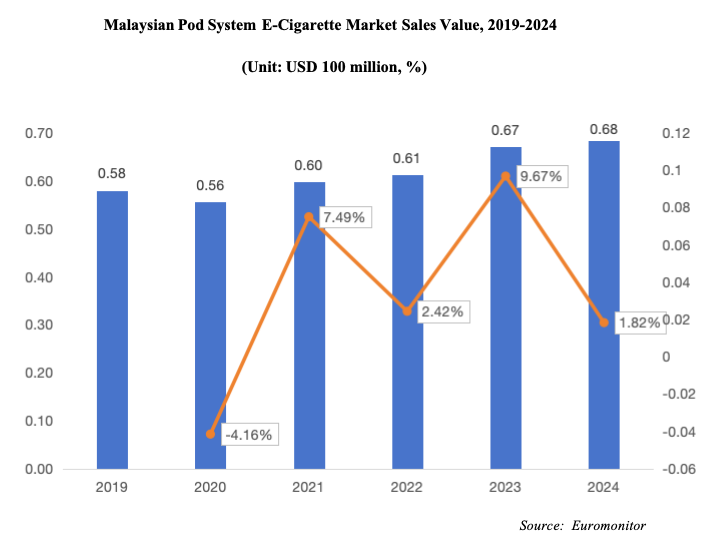
From 2019 to 2024, the Malaysian pod system e-cigarette market fluctuated between $58 million and $68 million. This segment consistently failed to break through growth barriers, constrained by open-system user stickiness, disposables' price competition, and its own technological shortcomings. In 2023, the segment experienced a brief recovery driven by price reductions and stockpiling ahead of excise tax implementation, but showed immediate weakness in 2024 after tax costs were passed on to consumers, reflecting the segment's lack of core competitiveness in the local market.
3.2、Malaysian Pod System E-Cigarette Segment Structure
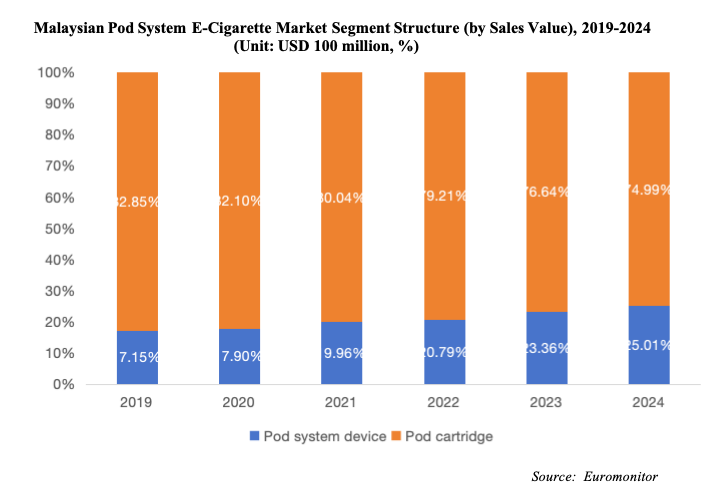
From 2019 to 2024, the Malaysian pod system market showed a gradual increase in device sales share and weakening pod dominance. Unlike mainstream markets, device sales share increased from 17.15% to 25.01%, driven by local brands attracting entry-level users through ultra-low pricing strategies and stockpiling ahead of excise tax implementation. Pod share declined from 82.85% to 74.99%, as high repurchase rates were difficult to achieve due to product experience deficiencies and price disadvantages. This pattern reflects the challenges the Malaysian pod system market faces in technology accumulation and user stickiness cultivation.
4.Malaysian Pod System E-Cigarette Sales Volume
4.1. Device Sales Volume
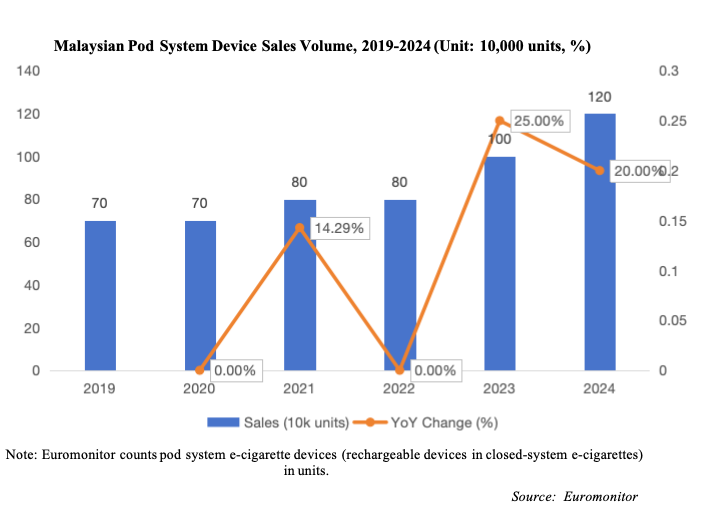
From 2019 to 2024, Malaysian pod system device sales volumes showed an overall upward trend. Growth was slow initially, with the market remaining relatively flat. A modest recovery began in 2021, followed by accelerated growth from 2023, with double-digit growth maintained for two consecutive years as the market gradually expanded after a period of stabilization.
4.2. Pod Sales Volume
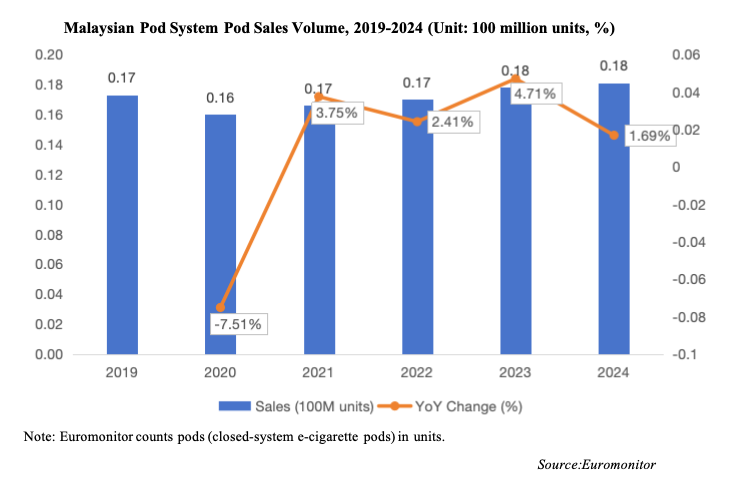
From 2019 to 2024, Malaysian pod sales volumes showed a slow but steady growth trend. Overall, the segment maintained relatively stable scale with limited growth momentum, operating at a low-speed growth rate.
5. Malaysian Pod System E-Cigarette Representative Brand Landscape
5.1、Overall Malaysian E-Cigarette Brand Market Share Analysis
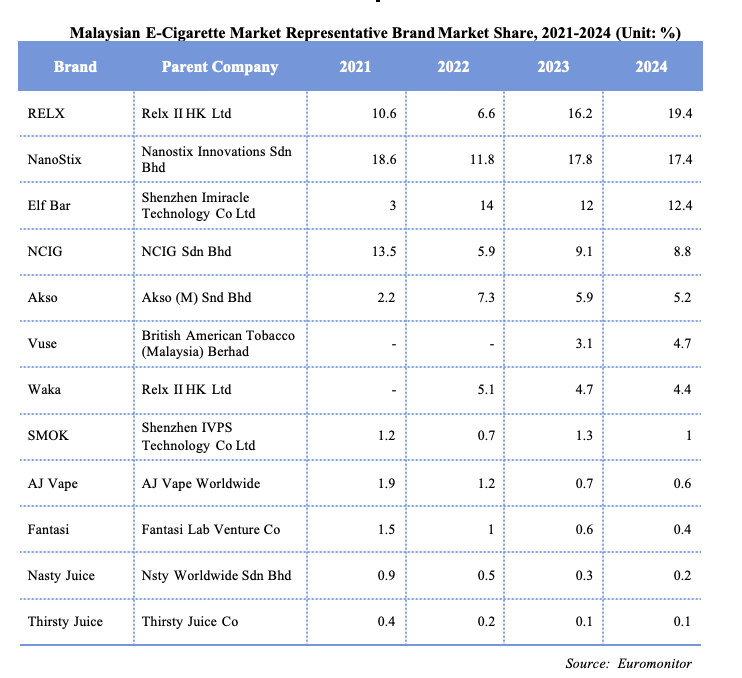
From 2021 to 2024, the Malaysian e-cigarette market competitive landscape became increasingly diversified. RELX showed strong performance with continued share expansion, gradually assuming a leading position. NanoStix maintained high share throughout the period. Elf Bar, NCIG, and other brands saw stabilizing or slightly declining shares amid intense competition. Overall, while market concentration remained relatively high, the influx of emerging and multinational brands intensified competition.
5.2、Malaysian Pod System E-Cigarette Representative Brand Analysis
In the Malaysian pod system market, RELX and ELFBAR are the two main representative brands. RELX holds a leading position through ceramic coil technology, large-capacity pods, and intelligent power regulation systems. ELFBAR, with its SNAP series featuring magnetic design and high puff counts, has achieved strong product differentiation.