1.German Pod System E-Cigarette Regulation
1.1 German E-Cigarette Legal Framework
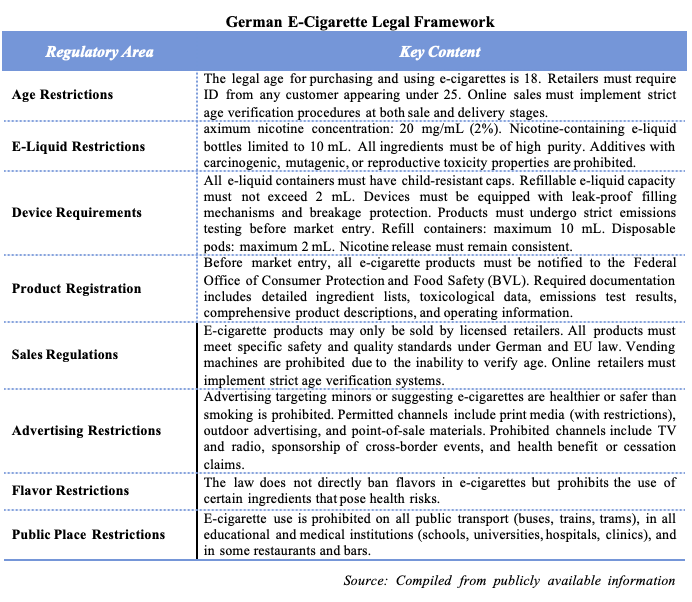
In the 21st century, e-cigarettes emerged in Germany as a new way of nicotine consumption. However, for a considerable period, Germany had no specific regulations or legal frameworks for e-cigarettes. In 2016, the EU enacted the Tobacco Products Directive (TPD), establishing strict guidelines for the production, marketing, and sale of e-cigarette products across all EU member states, including Germany. That same year, Germany adopted the Tobacco Products Act and transposed the EU TPD into German implementing regulations. In 2020, Germany published the Second Amendment to the Tobacco Products Act, further expanding the scope of e-cigarette regulation.
1.2 German E-Cigarette Tax Policy
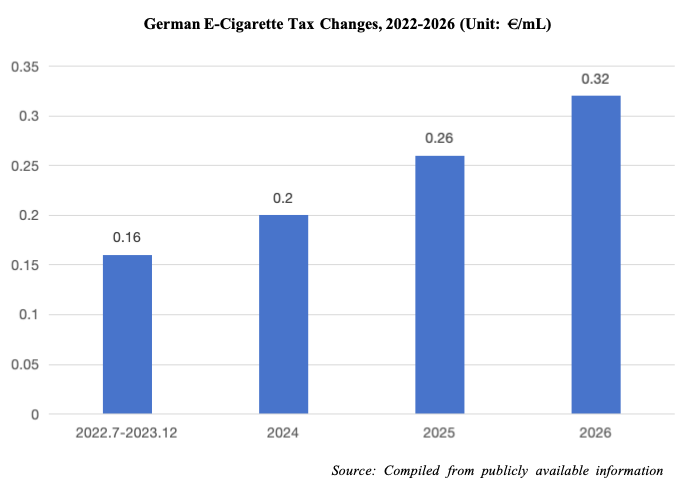
Before 2022, e-cigarettes in Germany were subject only to VAT, with no specific excise tax. In 2021, the German government passed the Tobacco Tax Modernization Act, aimed at gradually increasing tax rates on e-cigarettes and other tobacco products to respond to market changes and shifting consumer behavior. German e-cigarette taxation is primarily based on per-milliliter of e-liquid. From July 1, 2022, Germany began imposing an additional tobacco tax on e-cigarettes at a rate of €0.16 per milliliter of e-liquid (including nicotine-free e-liquids), with rates increasing annually and doubling by 2026.
2.Current Status of the German E-Cigarette Market
2.1 German E-Cigarette Market Sales Scale
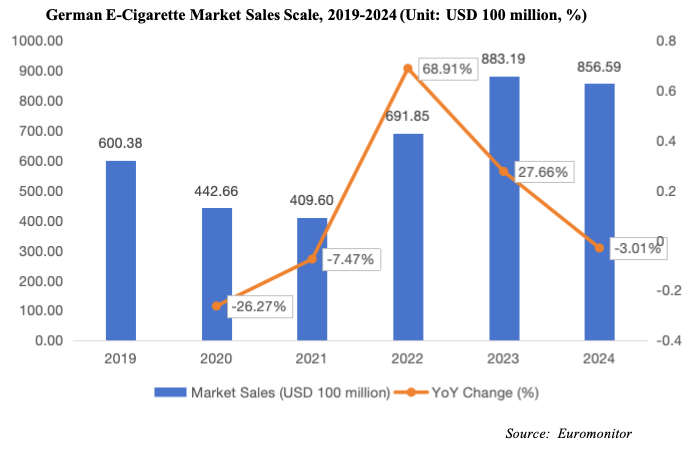
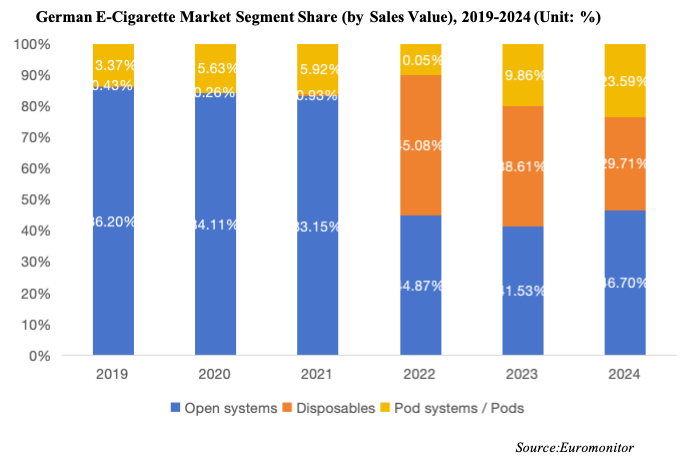
From 2019 to 2024, the German e-cigarette market experienced overall fluctuating growth, starting from approximately $0.6 billion and stabilizing at around $0.85 billion after significant volatility. In the early period, the industry contracted due to declining appeal of open systems and the impact of the pandemic. However, from 2022, disposable e-cigarettes rapidly penetrated younger demographics through low prices, diverse flavors, and convenience, achieving short-term explosive growth during a regulatory window. Entering 2024, with rising tax burdens, environmental pressures, and black market competition squeezing legitimate sales, the disposable product boom peaked, and the market entered a policy-driven structural adjustment period. Future growth will depend on compliant product transitions, channel normalization, and differentiated harm reduction scenarios.
2.2 German E-Cigarette Market Segment Structure
In recent years, the German e-cigarette market has gradually evolved into a three-way structure: open systems, disposables, and pod systems. From 2019 to 2024, although open systems continued to lose share, they maintained a resilient dominant position due to local consumer preferences for high-power customization and compliance advantages. Disposables experienced short-term explosive growth driven by a policy vacuum, followed by significant decline under environmental pressure and rising taxes. Pod systems achieved slow expansion under environmental regulations and government promotion of recyclable products. Overall, the market structure is shaped by the interplay of technological preferences, consumer culture, and policy direction. The future industry landscape will likely move toward a sustainable path of "compliance, environmental sustainability, and high repurchase rates."
3. German Pod System E-Cigarette Sales Value
3.1 German Pod System E-Cigarette Overall Sales Value
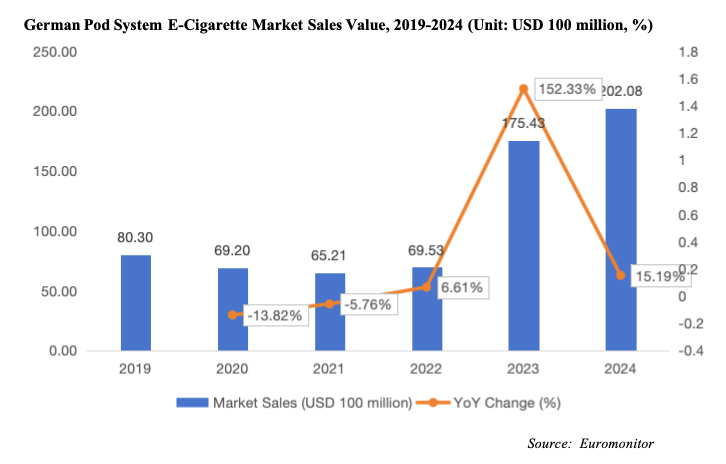
From 2019 to 2024, the German pod system e-cigarette market showed a trend of initial decline followed by growth, with total sales increasing from $0.80 billion to $2.02 billion. Although the market size remains relatively small, growth potential is significant. Early contraction was driven by insufficient technological adaptation and consumer preference for open systems. The later rebound was driven by environmental policy mandates, support from medical harm reduction scenarios, and restrictions on the illegal disposable market. Although growth slowed in 2024, the market has stabilized, demonstrating the sustainability of policy-driven substitution. Going forward, continued product performance optimization and lower price points could help pod systems gradually build a more loyal user base in Germany.
3.2 German Pod System E-Cigarette Segment Structure
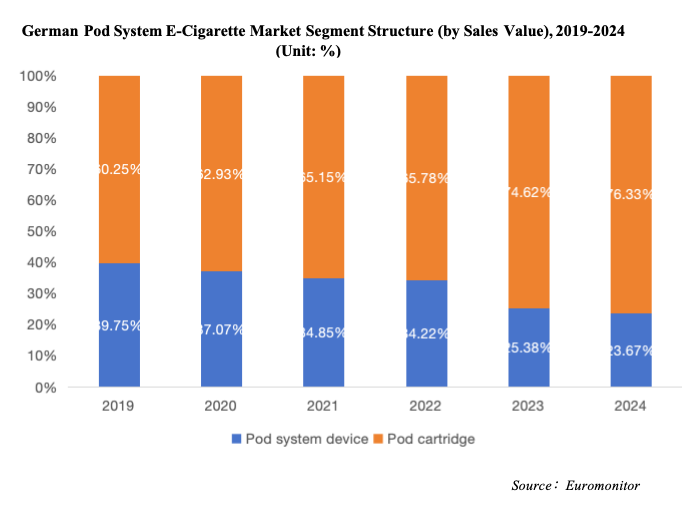
From 2019 to 2024, the German pod system e-cigarette market structure shifted significantly toward pod dominance, with pod sales share rising from 60.25% to 76.33%, becoming the core driver of industry growth. Government programs distributing free devices reduced retail demand for new devices, while high inflation extended device replacement cycles, contributing to the decline in device sales. Meanwhile, driven by environmental regulations and the healthcare system, pods gradually transitioned from consumer goods to high-frequency "medical consumables." High repurchase rates and compliance orientation together solidified their market dominance. Future pod market expansion will depend on compliance innovation, environmental adaptation, and refined channel operations.
4.German Pod System E-Cigarette Sales Volume
4.1. Device Sales Volume
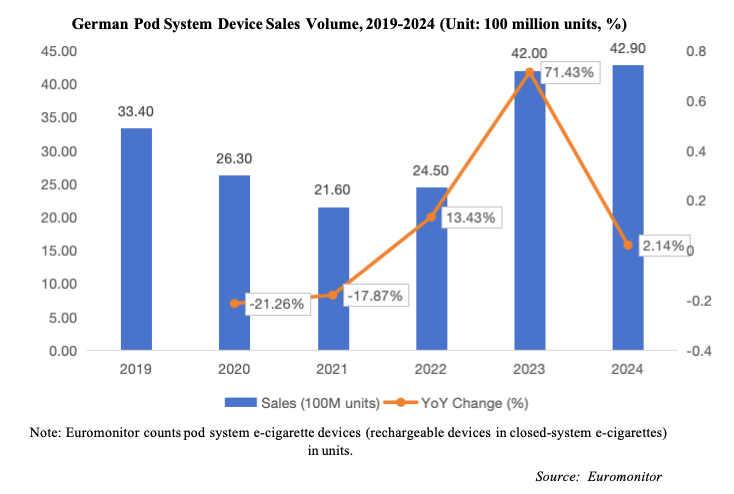
From 2019 to 2024, German pod system device sales volumes experienced a clear inflection point, declining first then rising. The market continued to decline in the early years, reaching a low point in 2021, followed by a strong rebound from 2022, significant growth in 2023, and stabilization in 2024. Overall, the market has gradually recovered after adjustments, showing a shift from contraction to recovery.
4.2 Pod Sales Volume
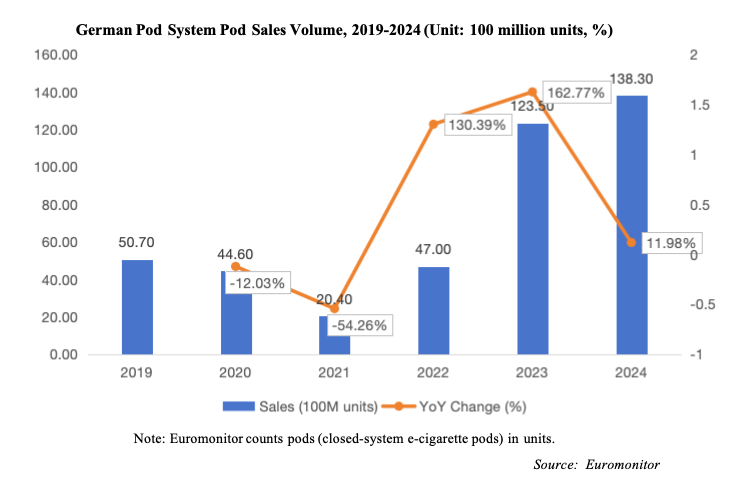
From 2019 to 2024, German pod sales volumes showed fluctuating trends. Sales declined significantly in 2020 and 2021. Since 2022, the market has experienced strong recovery, with rapid sales growth, continuing at high growth rates through 2023 and 2024. The pod market has achieved rapid expansion and stable growth.
5.German Pod System E-Cigarette Representative Brand Landscape
5.1 Overall German E-Cigarette Brand Market Share Analysis
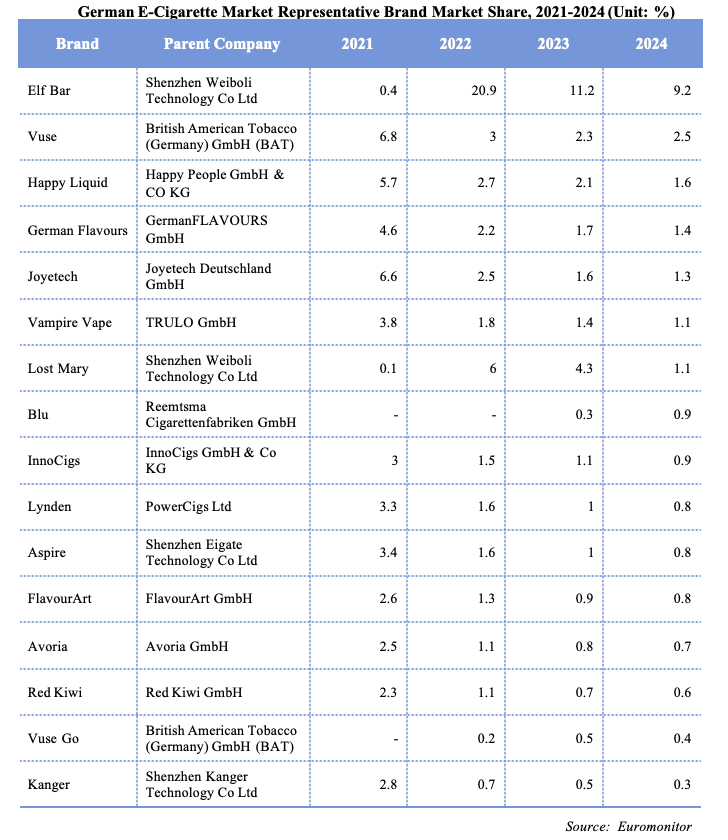
From 2021 to 2024, traditional German domestic brands and early market leaders continued to lose share, while Chinese brands represented by Elf Bar and Lost Mary rose rapidly. Although these brands saw some decline after peaking in 2022, they still maintained significant influence. Market concentration has clearly decreased, with top brand shares compressed and competition intensifying. Overall, the German market has evolved from a stable structure to a more fragmented, multi-player competitive landscape.
5.2 German Pod System E-Cigarette Representative Brand Analysis
In the German pod system e-cigarette market, OXVA appeals to high-vapor users with high-performance capabilities, targeting the specialty market. RELX has built strong mainstream coverage through technological stability and a broad retail network. SKE competes through cost-effectiveness and regional penetration in Eastern Europe, providing complementary coverage. Overall, the German market is evolving toward technological segmentation, channel expansion, and compliance adaptation.