1.UK Pod System E-Cigarette Regulation
1.1 UK TRPR Regulatory Framework
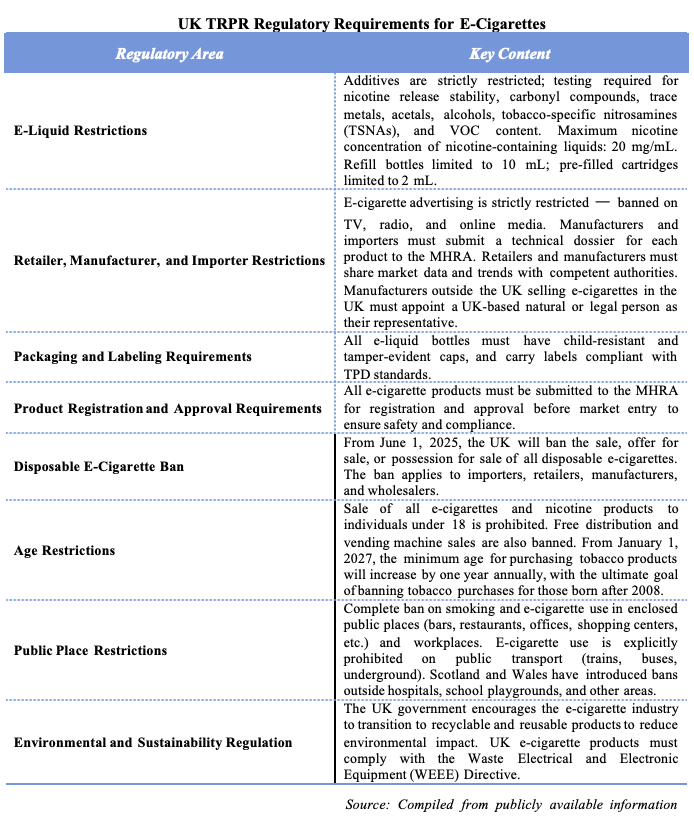
In 2010, the UK Medicines and Healthcare products Regulatory Agency (MHRA) held its first meeting on how to regulate e-cigarettes, proposing three options: a complete ban, requiring a medical license before market entry, or allowing natural development. Ultimately, following input from e-cigarette users, the UK chose to "wait and see." In 2014, the European Parliament formally approved the revised Tobacco Products Directive (TPD II), which for the first time brought e-cigarettes under the scope of tobacco product regulation. In 2016, the UK transposed the TPD into domestic law as the Tobacco and Related Products Regulations 2016 (TRPR). After the UK fully exited the EU in 2020, e-cigarette regulation continued to operate under the TRPR framework, maintaining the key provisions of the TPD. In 2024, the UK government announced a ban on the sale of disposable e-cigarettes in England and Wales to reduce youth vaping.
1.2 UK E-Cigarette Tax Policy
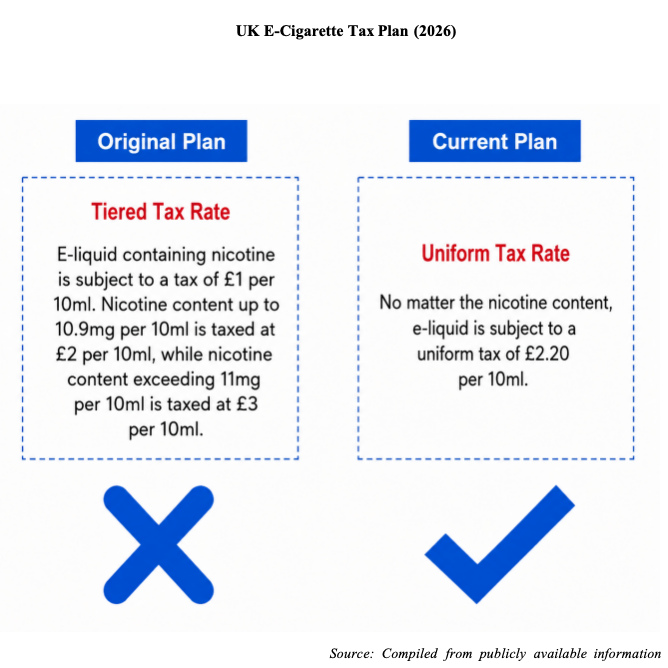
Before 2024, the UK did not have a specific tax for e-cigarettes, which were subject to the standard 20% VAT like most consumer goods. To reduce youth vaping and discourage non-smokers from starting, the UK plans to introduce an additional tax on e-cigarettes from October 2026. In early 2023, the UK first proposed a tiered tax rate for e-liquids: £1 per 10 mL for nicotine-free e-liquids, £2 per 10 mL for nicotine content below 10.9 mg, and £3 per 10 mL for nicotine content above 11 mg. However, this proposal was withdrawn following opposition. The UK ultimately adopted a flat tax rate of £2.20 per 10 mL of e-liquid, regardless of nicotine content.
2.Current Status of the UK E-Cigarette Market
2.1 UK E-Cigarette Market Sales Scale
From 2019 to 2024, the UK e-cigarette market experienced significant expansion, growing from $1.4 billion to over $4 billion, with a high base and gradually slowing growth rates. Early growth was primarily driven by rapid penetration of disposable e-cigarettes among youth, combined with government policy support positioning e-cigarettes as smoking cessation tools, creating a dual driver of demand and policy. However, following the 2024 government announcement of a disposable product ban, regulatory tightening has fundamentally changed the market's growth logic. Going forward, the UK e-cigarette market will transition from a "disposable-driven" model to a "compliant pod system + harm reduction application scenarios" model. While the market size has reached a high level, sustainability will depend on the depth of adult smoking cessation demand conversion and policy breakthroughs for innovative devices.

2.2 UK E-Cigarette Market Segment Structure
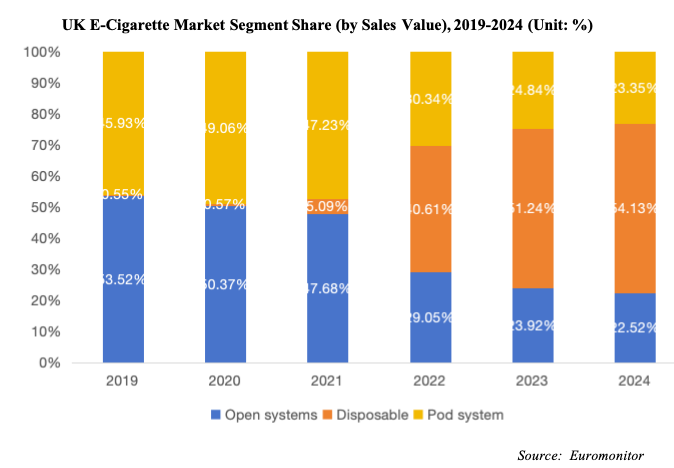
From 2019 to 2024, the UK e-cigarette market structure underwent a dramatic transformation. Initially dominated by open systems and pod systems, the market quickly shifted to a disposable-dominant structure. Disposable products, leveraging fruit flavors, low prices, and social media, achieved deep penetration among youth in a regulatory vacuum, with market share soaring to over 50% within three years, fundamentally reshaping the industry structure. This wave of consumption formed "unrestrained growth" against a backdrop of regulatory lag, driving the disruptive expansion of disposables.
However, the unsustainability of this growth model has become increasingly evident. At the policy level, the 2025 disposable product ban signals a return to rational regulation, with the market entering a transition period. As the disposable boom peaks, pod systems have seen modest recovery driven by policy exemptions, while open systems continue to be marginalized due to limited convenience and innovation. Overall, the UK e-cigarette industry is shifting from a "hit-driven" youth consumption logic to a "compliance-driven repurchase" adult harm reduction logic. The future focus will return to product quality, health functionality, and regulatory adaptability.
3.UK Pod System E-Cigarette Sales Value
3.1 UK Pod System E-Cigarette Overall Sales Value
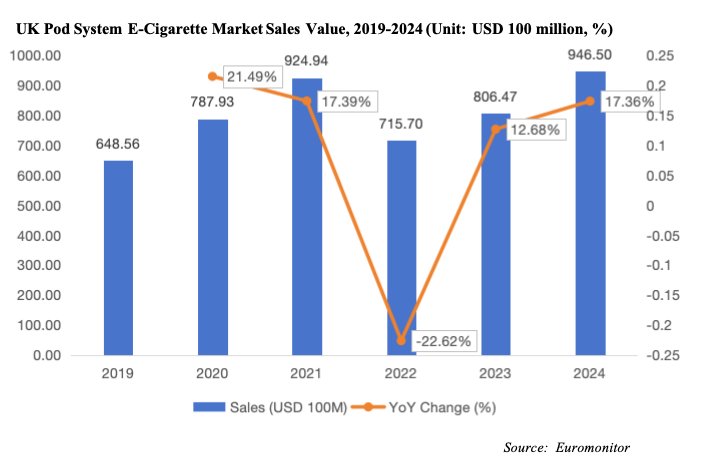
From 2019 to 2024, the UK pod system e-cigarette market showed a trend of "initial growth, then decline, then recovery," with sales rising from $649 million to $946 million. Early growth benefited from the government's inclusion of e-cigarettes in the public health system, combined with strong compliance of the products themselves, creating a policy-friendly environment. In 2022, the market was significantly impacted by the low prices and variety of flavors offered by disposable e-cigarettes, severely squeezing pod system share. From 2023, as the disposable ban became clearer and channels began structural shifts, combined with government promotion of harm reduction programs and environmental policy support for circular products, the pod system market achieved steady recovery and regained growth momentum. Going forward, if the pod system can strengthen its application value in medical harm reduction and environmental scenarios, it is well-positioned to become the core pillar of the market's long-term compliant growth.
3.2 UK Pod System E-Cigarette Segment Structure
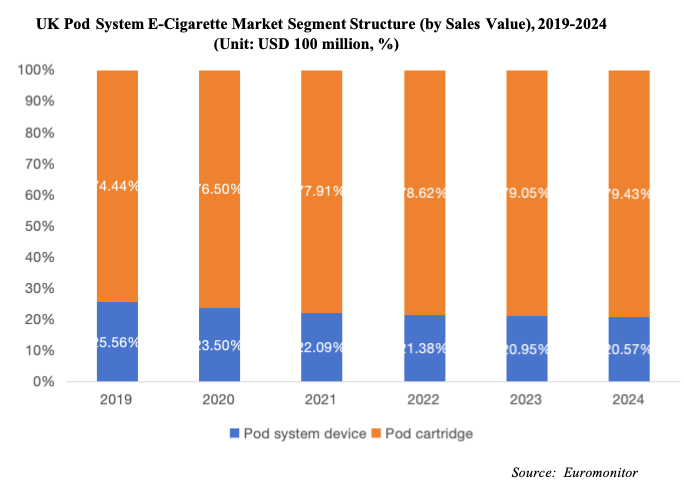
From 2019 to 2024, the UK pod system e-cigarette market structure showed a consumable-driven characteristic, with device sales share continuing to decline while pod consumption share continued to rise. This reflects a structural transition from hardware-driven to repurchase-driven models. Against a backdrop of saturated consumer ownership and slowing product iteration, the device segment has entered a maintenance cycle, with sales share dropping to around 20%. Conversely, pods, due to their essential repurchase nature, have been further boosted by the disposable ban, harm reduction policy alignment, and closed-loop operations of leading brands, becoming the primary engine driving market growth.
4.UK Pod System E-Cigarette Sales Volume
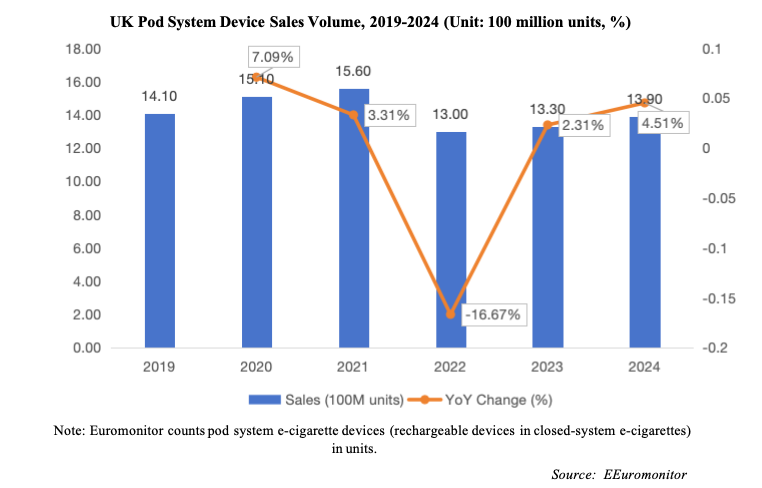
4.1. Device Sales Volume
From 2019 to 2024, UK pod system device sales volumes showed a fluctuating yet stabilizing trend. There was slight early growth, but a significant decline occurred from 2022, with modest recovery thereafter. Overall, the market remained relatively stable at a low level, indicating limited growth potential and market saturation for this category in the UK.
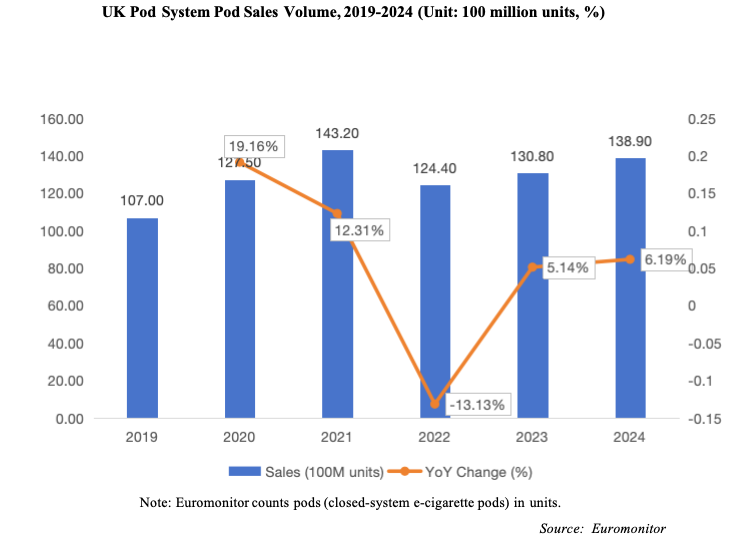
4.2. Pod Sales Volume
From 2019 to 2024, UK pod sales volumes showed an overall upward trend. A notable decline occurred in 2022, but the overall trend showed a year-on-year recovery, with accelerated growth in 2023 and 2024.
5.UK Pod System E-Cigarette Representative Brand Landscape
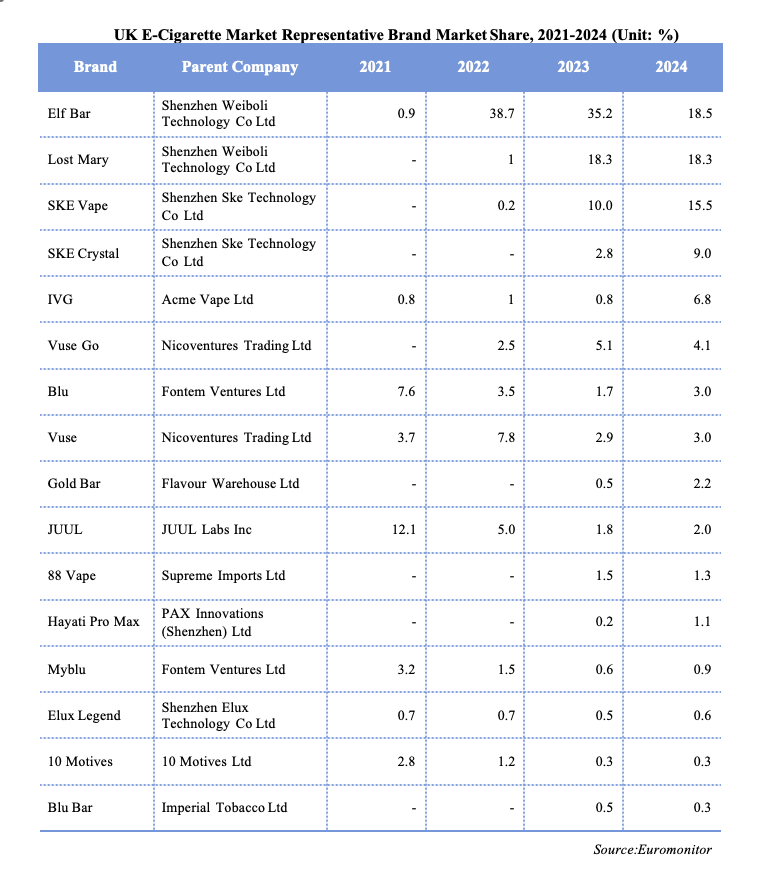
5.1 Overall UK E-Cigarette Brand Market Share Analysis
From 2021 to 2024, the UK e-cigarette market saw established brands such as JUUL and Blu continue to lose share, while emerging disposable brands rapidly gained ground. Elf Bar reached its market peak in 2022, dominating the market, but saw a significant decline in 2024. Newer brands such as Lost Mary and SKE rapidly expanded their share. Overall, the market has shifted from traditional pod systems to disposables, with the competitive landscape evolving from a few established brands to a more fragmented and diversified market with multiple emerging brands rising.
5.2、UK Pod System E-Cigarette Representative Brand Analysis
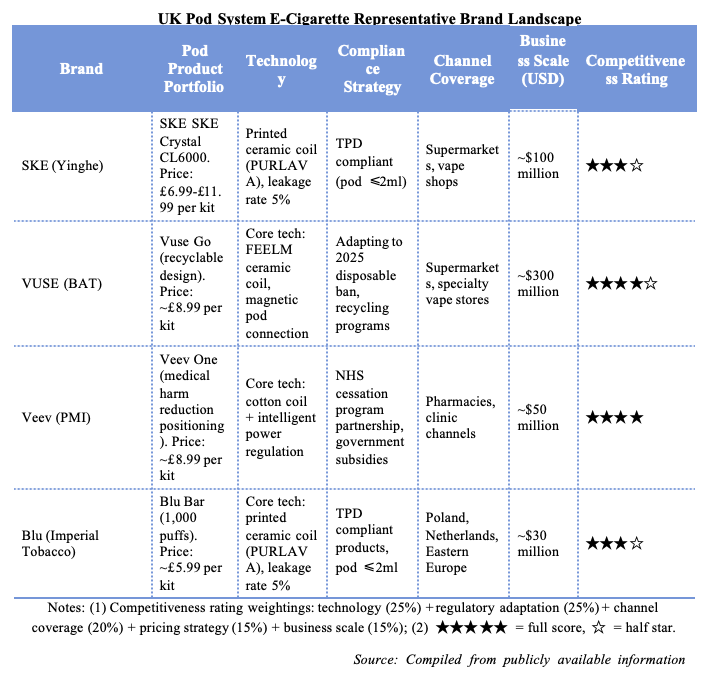
In the UK pod system e-cigarette market, VUSE leads in compliance and technology with its advanced FEELM ceramic coil technology and environmental recycling programs, demonstrating strong competitiveness. Veev distinguishes itself through its medical harm reduction positioning and collaboration with the NHS, leveraging government subsidies and channel development to secure a position in the compliant market. Blu has established a presence in Eastern Europe through printed ceramic coil technology and compliant pod offerings, though its overall technology is somewhat less advanced. Overall, the UK pod system e-cigarette market is relatively competitive, with differentiation strategies in technological innovation, regulatory adaptation, and channel expansion becoming key determinants of future competitiveness.