1. US Pod System E‑Cigarette Regulation
1.1 FDA E‑Cigarette Regulation
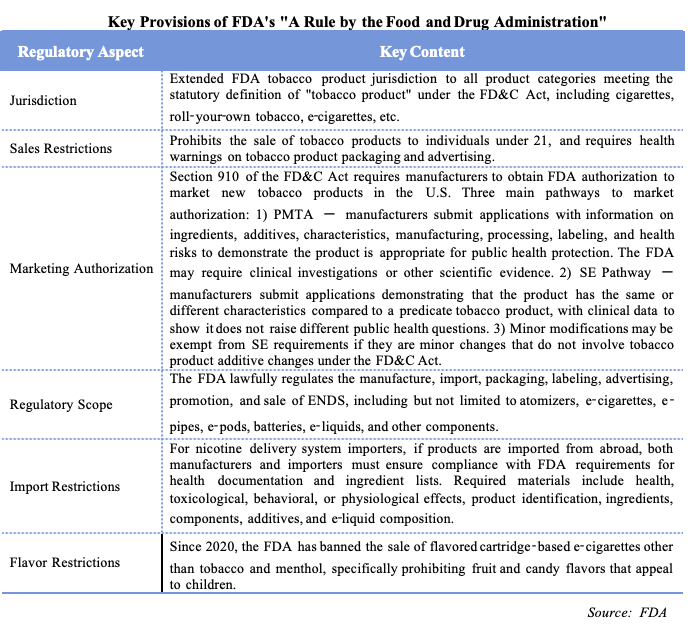
In the United States, e‑cigarette products are regulated as tobacco products. In 2010, the U.S. Court of Appeals for the District of Columbia Circuit ruled that the FDA has the authority to regulate tobacco products sold in the ordinary course of trade under the Tobacco Control Act, and to regulate tobacco products sold for therapeutic purposes under the medical product provisions of the Food, Drug, and Cosmetic Act. In 2016, the FDA's Center for Tobacco Products (CTP) extended FDA regulatory authority to all products that meet the definition of "tobacco product" under the Food, Drug, and Cosmetic Act. From that point forward, all newly deemed tobacco products, including e‑cigarettes, must undergo FDA premarket review and authorization.
The FDA lawfully regulates the manufacture, import, packaging, labeling, advertising, promotion, and sale of Electronic Nicotine Delivery Systems (ENDS), including but not limited to atomizers, e‑cigarettes, e‑pipes, e‑pods, batteries, e‑liquids, and other components. In ENDS regulation, if hardware components are sold separately, manufacturers face increased difficulty in providing the required statutory standards of proof. Therefore, manufacturers are more likely to succeed when applying for authorization for the entire ENDS system rather than individual components. The Act clarifies that nicotine‑containing pods with varying nicotine levels are components or parts of nicotine delivery systems and are subject to FDA jurisdiction under the Federal Food, Drug, and Cosmetic Act.
1.2、State and Local E‑Cigarette Regulation
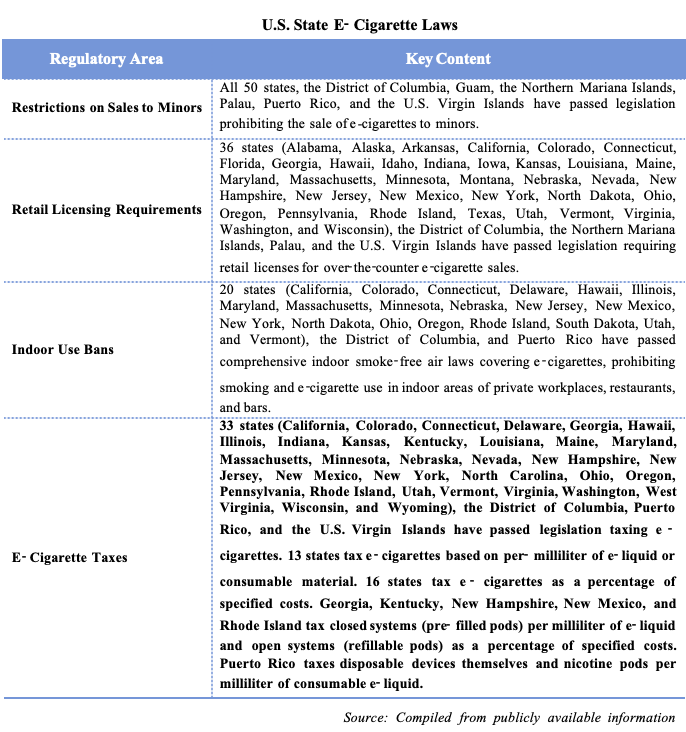
Under the Tobacco Control Act, U.S. states and local governments have the authority to impose additional or stricter legal restrictions on the use, sale, marketing, and other aspects of tobacco products under the FD&C Act. State and local governments have enacted various laws and regulations related to e‑cigarettes to reduce youth initiation and use. Regulatory measures include restricting e‑cigarette sales to minors, retail licensing requirements, indoor use bans, and e‑cigarette taxes.
1.3、State and Local E‑Cigarette Taxes
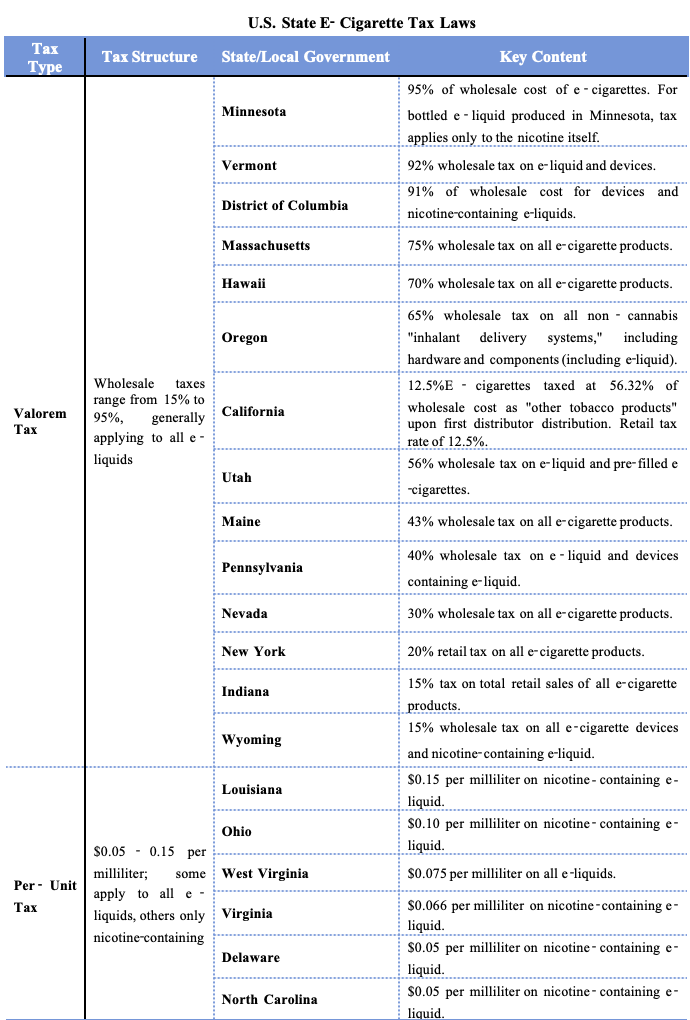
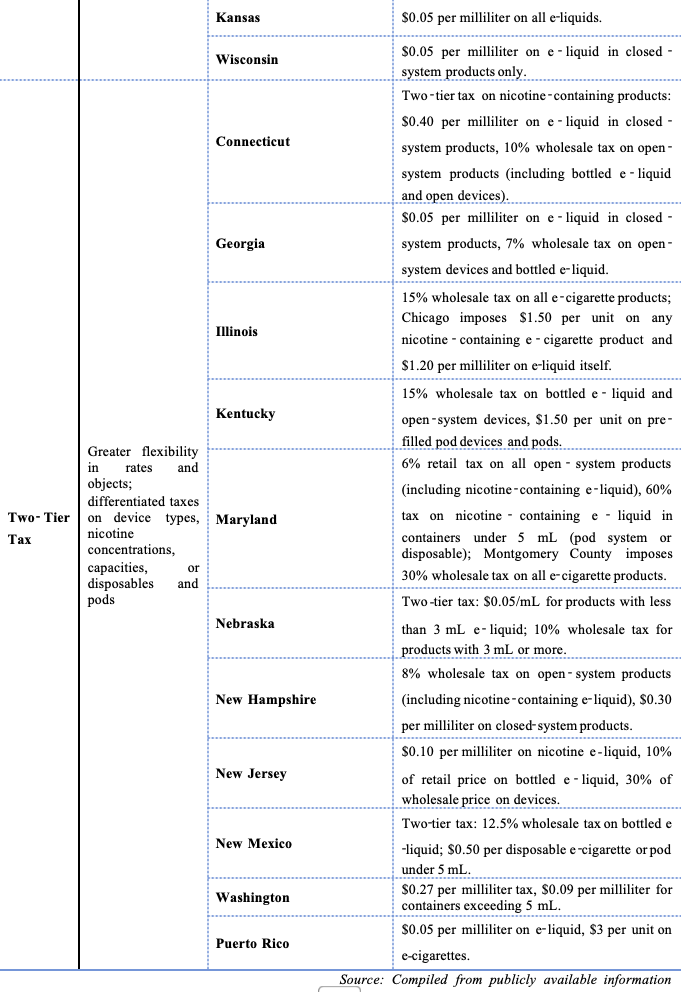
Regarding e‑cigarette taxation, there are significant differences in tax approaches among states and local governments. State tax policies primarily include ad valorem taxes (as a percentage of wholesale or retail prices) and per‑unit taxes (fixed amounts per milliliter or per unit), with some regions imposing two‑tier taxes. U.S. states often adopt different tax schemes for open‑system (pod system) and closed‑system (disposable) e‑cigarettes.
U.S. states impose wholesale taxes ranging from 15% to 95%, generally applying to all e‑liquids. Per‑milliliter taxes range from $0.05 to $0.15 per milliliter, with some states applying the tax to all e‑liquids and others only to nicotine‑containing e‑liquids. States with two‑tier taxes have greater flexibility in tax rates and objects, allowing for differentiated taxation on various types of devices, nicotine concentrations, capacities, or disposables and pods.
2.Current Status of the U.S. E‑Cigarette Market
2.1 U.S. E‑Cigarette Market Sales Scale
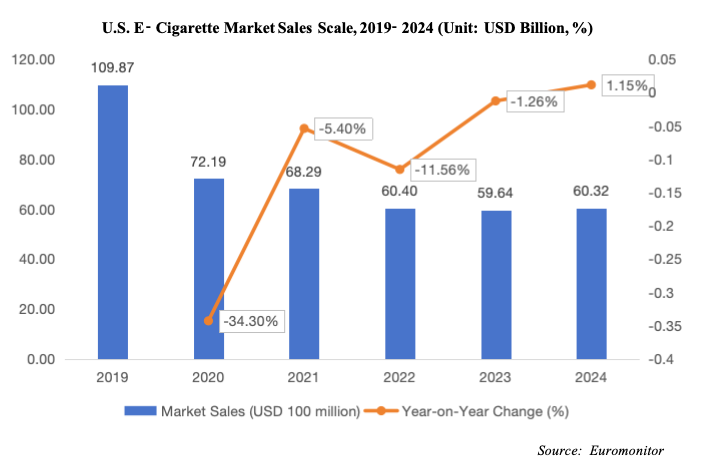
From 2019 to 2024, U.S. e‑cigarette market sales declined from approximately $11 billion to around $6 billion, a significant contraction of over 45% followed by tentative stabilization. This reflects the industry's transition from a phase of rapid expansion to deep structural adjustment, driven by two main factors: on one hand, flavor bans and stringent regulations compressed the legal market, forcing consumers toward illegal or lightly regulated channels; on the other hand, the proliferation of black‑market disposable products and the rise of alternatives like nicotine pouches further diverted users. Although the market showed modest recovery signs in 2023, this was primarily driven by structural repair in compliant pod system products and channel reorganization by leading brands. Overall, the U.S. e‑cigarette market is transitioning from "unrestrained growth" to "compliance‑driven restructuring." While sales may not return to peak levels soon, the market is gradually moving toward a healthier, more sustainable business model.
2.2 U.S. E‑Cigarette Market Segment Structure
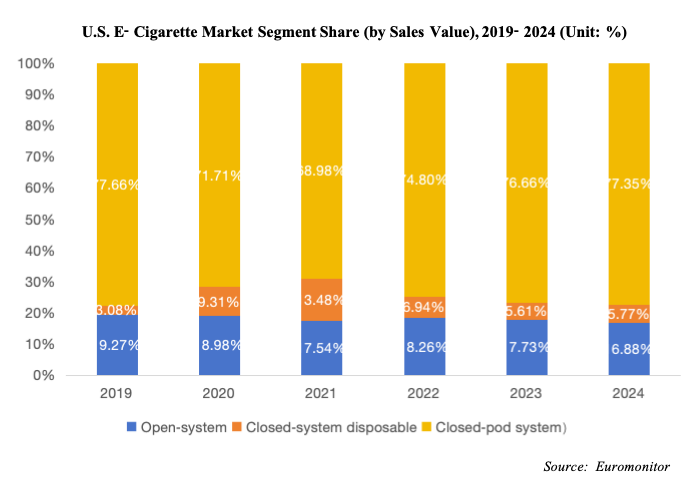
Between 2019 and 2024, the U.S. e‑cigarette market structure increasingly concentrated on closed‑system pod devices, which maintained over 75% market share throughout the period, demonstrating clear dominance. This is driven by three factors: regulatory compliance advantages, technological evolution, and consumer habits. As FDA regulatory policies tightened, pod system products gradually passed PMTA reviews and obtained legal sales qualifications. Core technologies such as FEELM ceramic coils significantly improved user experience and reduced failure rates. Furthermore, as pod devices became widely adopted among middle‑ and high‑income groups, the existing device base drove high‑frequency pod replacements, building a stable consumption ecosystem.
In contrast, disposable and open‑system e‑cigarettes faced regulatory crackdowns and technological/policy marginalization. Although disposables once gained market share through flavor variety and low prices, they were quickly targeted by the FDA, with compliance gaps becoming a critical weakness. Open‑system products, burdened by high taxes and DIY requirements, were gradually phased out of mainstream markets. Overall, the U.S. e‑cigarette segment structure is transitioning from "flavor‑driven" to "compliance‑driven and technology‑driven," with the industry ecosystem shifting from free competition to highly concentrated and regulatory‑dominated patterns.
3. U.S. Pod System E‑Cigarette Market Size
3.1 U.S. Pod System E‑Cigarette Sales Value
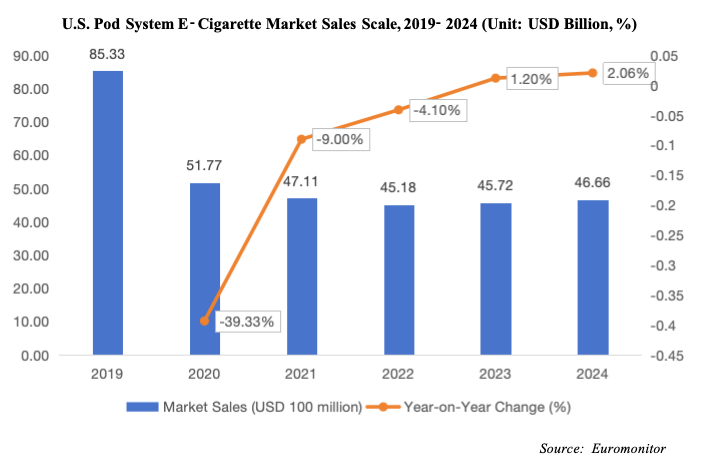
Between 2019 and 2024, U.S. pod system e‑cigarette sales declined from $8.5 billion to approximately $4.7 billion, a cumulative drop of over 45%, with modest stabilization in recent years. Early on, flavor bans and high taxes severely impacted core user groups, while the influx of illegal disposable products further squeezed the pod ecosystem. However, since 2023, as regulations shifted toward compliance, the FDA approved menthol‑flavored products for the first time, and leading brands improved user experience through technological advantages, pod system e‑cigarettes began showing signs of bottoming out. Overall, while current market size remains below peak levels, the role of pod system products as the primary compliant format is increasingly clear. Future growth will rely more on quality‑driven recovery through policy relaxation, technological upgrades, and channel integration, rather than short‑term volume expansion.
3.2 U.S. Pod System E‑Cigarette Segment Structure
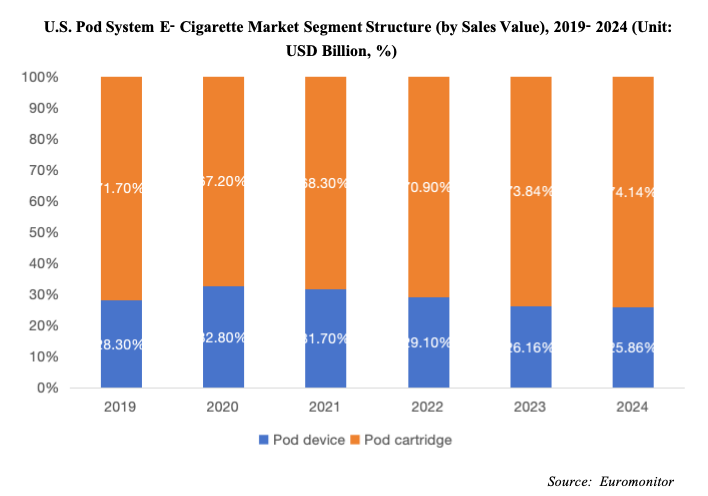
Between 2019 and 2024, the U.S. pod system e‑cigarette market structure gradually shifted from "device‑driven" to "pod‑dominated." Device sales share declined to below 26%, while pods steadily rose to over 74%. This structural shift reflects that under regulatory pressure and innovation constraints, consumers are moving toward "low‑frequency device purchases + high‑frequency consumable replenishment." On the device side, stringent PMTA reviews and limited design innovation, combined with consumers extending device lifecycles amid high inflation, have resulted in slower new product launches and weaker replacement demand – a classic pattern of "functional stabilization + weakened consumption."
Meanwhile, pods have become the core growth driver sustaining market vitality. Leading brands enhance repurchase intent through technology integration, patent portfolios, and high experience consistency. Although black‑market competition weakens new users' interest in legitimate devices, it increases existing users' dependence on compliant pods. Overall, the U.S. pod system e‑cigarette market is moving toward a "consumable‑driven" structural fixation. Future growth will depend more on user retention and replenishment frequency rather than device upgrades. If regulations create space for device innovation – such as permitting flavor and functional iteration – the device segment could achieve structural recovery.
3.U.S. Pod System E‑Cigarette Sales Volume
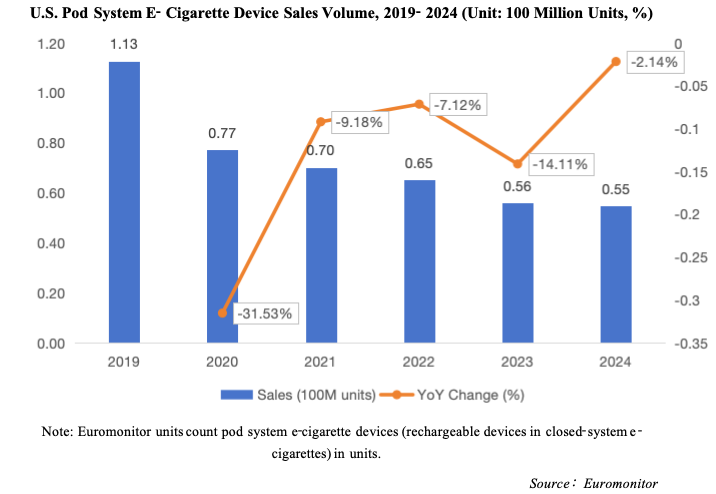
From 2019 to 2024, U.S. pod system e‑cigarette device sales volumes showed a continuous downward trend. Sales reached 113 million units in 2019, but declined each subsequent year, with particularly notable drops of 31.53% in 2020 and 14.11% in 2023. Overall, sales volumes have decreased year‑by‑year with narrowing declines, projected to reach 55 million units in 2024, a decrease of 2.14%.
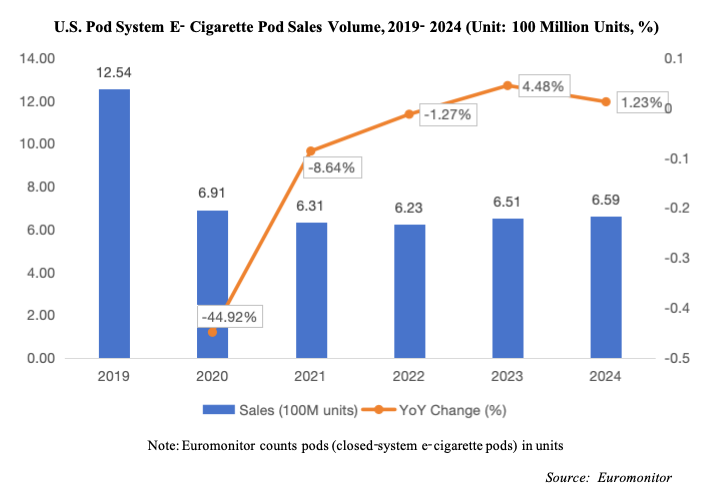
From 2019 to 2024, U.S. pod sales volumes experienced an initial decline followed by stabilization. After reaching a peak in 2019, sales dropped significantly in 2020 due to various policy and market factors, with declines gradually narrowing in subsequent years. Since 2022, the market has stabilized, showing modest recovery in 2023 and continuing moderate growth in 2024. Overall, the U.S. pod market has entered a relatively stable development phase after earlier adjustments, with signs of recovery emerging.
4. Representative Brand Landscape in U.S. Pod System E‑Cigarettes
4.1 Overall U.S. E‑Cigarette Brand Market Share Analysis
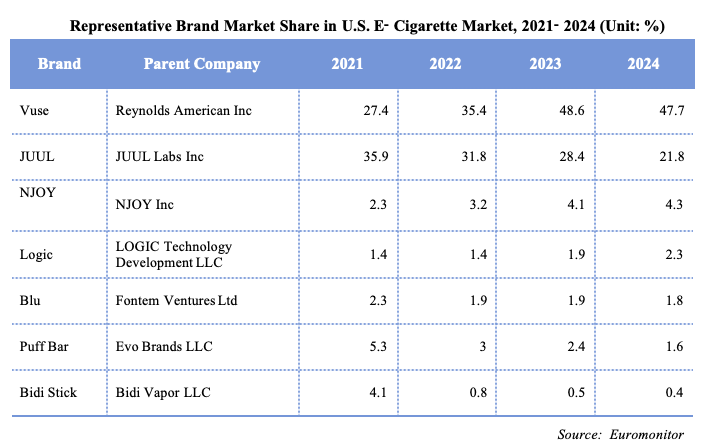
From 2021 to 2024, the U.S. e‑cigarette market share distribution has become increasingly concentrated. Vuse continued its expansion, maintaining approximately 47.7% market share by 2024, nearly half of the total market. JUUL experienced sustained decline, dropping from 35.9% in 2021 to 21.8% in 2024. Other brands like NJOY and Logic showed modest growth. Puff Bar and Bidi Stick continued losing share as the market consolidated toward larger brands. Overall, the U.S. e‑cigarette market is evolving toward a Vuse‑dominated landscape, with JUUL's decline and smaller brands' marginalization further increasing market concentration.
4.2 Representative Brand Landscape in U.S. Pod System E‑Cigarettes
In the U.S. pod system e‑cigarette market, JUUL and NJOY lead through technological differentiation (JUUL's cotton‑wick atomization vs. NJOY's ceramic coil) and FDA compliance strategies. NJOY demonstrates strong competitiveness and market adaptability through ceramic technology and FDA menthol authorization. MEMERS pursues market share through product differentiation and compliance innovation, targeting replacement demand following the disposable ban.