The global regulatory response to New Generation Tobacco (NGT) products — e‑cigarettes, heated tobacco, and nicotine pouches — has splintered into two fundamentally opposed philosophies. On one side: total or near‑total prohibition, rooted in the precautionary principle. On the other: risk‑proportionate, tiered regulation that treats NGT products according to their relative harm compared to combustible cigarettes.
Nowhere is this philosophical divide more visible — and more politically charged — than in the unfolding battle over nicotine pouches. In early 2026, France formalised one of the most sweeping bans on nicotine pouches in the European Union, igniting a fierce debate about public health, youth protection, and the integrity of the EU single market. Meanwhile, the United States and the United Kingdom continue to refine their respective regulatory pathways — one grounded in rigorous premarket scientific review, the other rooted in harm reduction.
This article unpacks the two regulatory paths, examines the French ban and its EU-wide repercussions, and asks whether a coherent global framework for NGT products is possible.
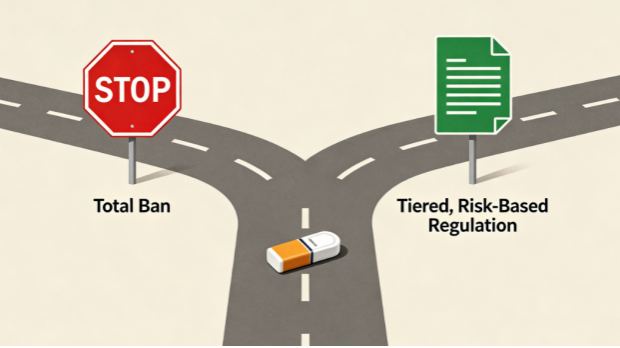
Two Roads Diverging in Nicotine Regulation
The regulatory spectrum is defined by two endpoints:
· The Prohibitionist Approach: Treat all novel nicotine products as a threat until proven safe. Products are banned or restricted to such an extent that market access is virtually impossible. The rationale is precautionary: if the long‑term health effects are unknown, and youth uptake is a risk, the safest course is to keep the product off the market entirely.
· The Tiered, Risk‑Proportionate Approach: Regulate nicotine products according to their level of risk, allowing lower‑harm alternatives to remain accessible to adult smokers while imposing strict controls to minimise youth access and misleading marketing. This approach accepts that some nicotine products can play a role in reducing smoking‑related mortality.
France, the United States, and the United Kingdom are now the most prominent examples of how these two philosophies translate into concrete policy — with consequences that ripple far beyond their borders.
France: The Ban, the Backlash, and the Single Market Question
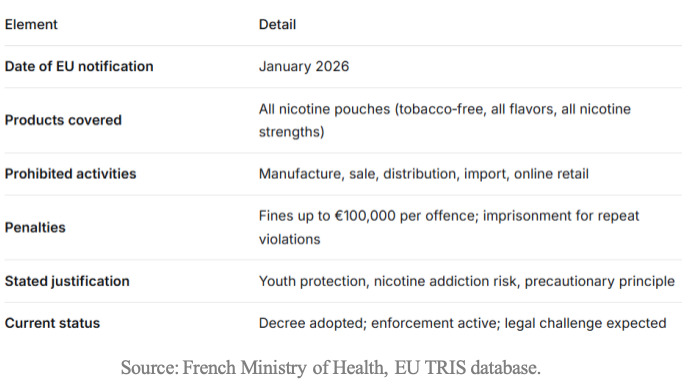
In January 2026, the French government notified the European Commission of a draft decree to prohibit the manufacture, sale, distribution, and importation of nicotine pouches on its entire territory. The ban covers all nicotine pouches, regardless of nicotine strength or flavor, and imposes severe financial penalties for non‑compliance. The government’s justification was unambiguous: nicotine pouches represent a new vector of nicotine addiction, their marketing targets youth through candy‑like flavors and social media, and their long‑term health effects remain insufficiently studied. France invoked the precautionary principle and declared the products a threat to public health.
The move immediately drew sharp criticism from multiple quarters — and not only from the tobacco and nicotine industry.
The Single Market Collision
Under EU law, a Member State intending to ban a product lawfully marketed in other Member States must notify the European Commission and provide a public health justification that withstands scrutiny under Articles 34‑36 of the Treaty on the Functioning of the European Union (TFEU). The ban must be proportionate, non‑discriminatory, and based on solid evidence.
Critics argue that France’s blanket ban fails the proportionality test. Nicotine pouches are legally sold in numerous EU countries: Sweden, where oral nicotine products have a long history, treats them under a dedicated, light‑touch legislative framework; Germany’s pending nicotine pouch law proposes content and labeling rules rather than prohibition; Denmark, despite its restrictive flavor stance, has not banned the product entirely. Even the European Commission’s own preliminary view, expressed in the context of the Tobacco Products Directive (TPD) revision, leans toward regulation — not prohibition — for nicotine pouches.
The French ban therefore creates a fracture in the single market. Swedish Match, a leading manufacturer now under Philip Morris International, has indicated it will challenge the ban if it is not amended. Several EU Member States privately fear that France’s unilateral action could trigger a domino effect, with each country adopting incompatible national rules and dismantling the principle of mutual recognition that underpins the common market.
Publicly, the French health ministry maintains that the ban is fully compliant with EU law and that national sovereignty over public health permits such measures. Behind the scenes, officials in Brussels are said to be deeply uncomfortable — not necessarily with the public health goal, but with the precedent of unilateral prohibition for a product already regulated or tolerated elsewhere in the bloc.
Table 1: France’s Nicotine Pouch Ban — Key Details
The United States: The Scientific Gatekeeper Model
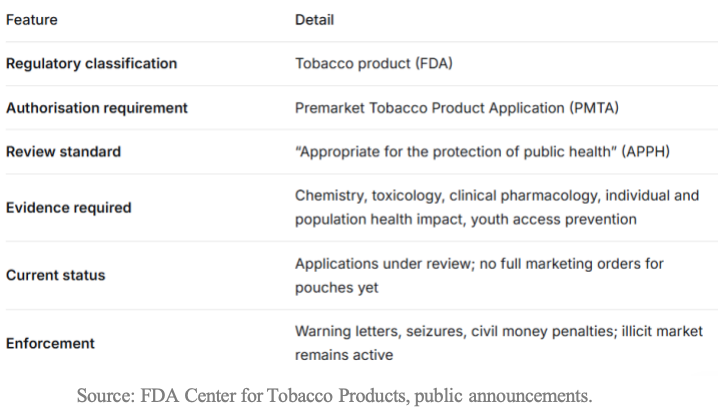
The United States offers a contrasting model: not a ban, but a stringent, science‑based premarket authorisation system that serves as a powerful gatekeeper. Under the Family Smoking Prevention and Tobacco Control Act, nicotine pouches are classified as tobacco products regulated by the FDA’s Center for Tobacco Products, and manufacturers must submit a Premarket Tobacco Product Application (PMTA) demonstrating that the marketing of the product is “appropriate for the protection of public health.”
This statutory standard forces a holistic weighing of risks and benefits: the FDA must consider the likelihood that existing tobacco users will stop using more harmful products, as well as the likelihood that non‑users, particularly youth, will start. It is not a ban, but it is an extraordinarily high bar. Of the millions of flavored e‑cigarette applications received, only a handful of menthol and tobacco‑flavored products have been authorised. For nicotine pouches, the review process is ongoing. The agency has signalled that products with strong adult‑switching evidence and robust youth‑access prevention measures stand a realistic path to authorisation — but no nicotine pouch has yet received a full PMTA marketing order as of mid‑2026.
This model is neither prohibition nor free market. It is a technocratic, evidence‑driven filter that, in theory, allows beneficial products through while blocking those that pose a net population‑level harm. The operational reality, however, is one of intense legal contestation, a backlog of applications, and a widespread illicit market for unauthorised flavored products. Critics say the system is too slow and too opaque; supporters say it is the only rational way to separate genuine harm‑reduction tools from youth‑focused nicotine delivery devices.
Table 2: The US PMTA Pathway for Nicotine Pouches — Key Characteristics
The United Kingdom: Harm Reduction as Regulatory North Star
The United Kingdom occupies the third point of the triangle. Its approach to nicotine pouches — and to NGT products more broadly — is guided by a public health philosophy that explicitly endorses harm reduction. The landmark 2015 Public Health England review, which estimated e‑cigarettes to be around 95% less harmful than smoking, has shaped a regulatory culture that prioritises smoking cessation over nicotine elimination.
Nicotine pouches currently sit in a regulatory grey zone in the UK: they are sold under the General Product Safety Regulations 2005, with no specific authorisation or notification scheme analogous to the TPD for e‑cigarettes. The Medicines and Healthcare products Regulatory Agency (MHRA) has clarified that any pouch making medicinal claims (e.g., smoking cessation) must obtain a marketing authorisation as a medicine. Absent such claims, the products remain on the market as consumer goods, subject to general safety law and robust age‑verification requirements.
This permissive posture is now under review. The UK government has indicated it is developing a dedicated regulatory framework for nicotine pouches that would likely include:
· A formal product notification system.
· Maximum nicotine content limits.
· Flavor restrictions to reduce youth appeal.
· Standardised health warnings.
But the overarching principle remains: regulation, not prohibition. The UK’s independent Khan Review (2022) called for the promotion of vaping and other smoke‑free alternatives as smoking cessation tools. The policy direction is clear: if a product can demonstrably help smokers quit, and its youth uptake can be contained, it should be available.
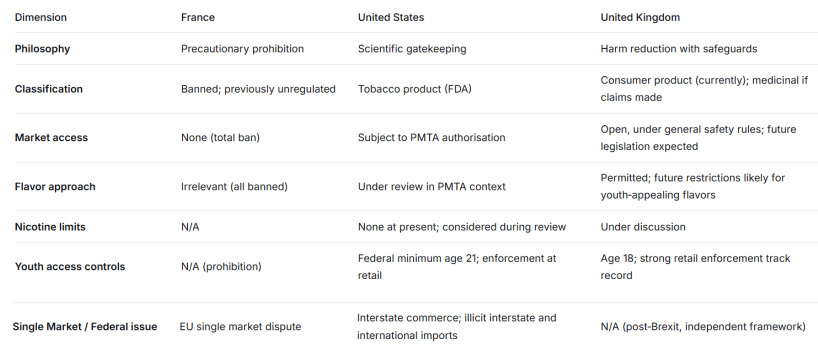
Table 3: Comparative Nicotine Pouch Regulatory Frameworks — France, US, UK (2026)
The Consequences of the Divergence
The clash between France’s prohibitionist stance and the tiered-regulation models in the US and UK has tangible consequences — for public health, for the rule of law, and for the industry.
· Illicit market growth: In France, the ban has already driven nicotine pouches underground. Online sales from cross‑border EU vendors have surged, and French customs authorities report a sharp increase in small‑parcel seizures. Consumers are obtaining products from Sweden and Germany, often with no age verification or quality control. A similar dynamic was observed in Australia after its prescription‑only model for nicotine e‑cigarettes was introduced.
· Regulatory fragmentation in the EU: France’s ban has exposed the absence of a harmonised EU approach to nicotine pouches. With the Tobacco Products Directive revision not expected before 2027, the window for unilateral national bans remains open. This threatens the single market and creates compliance chaos for manufacturers who must navigate 27 different rulebooks.
· Industry adaptation: Multinational nicotine companies are responding by segmenting their product strategies — offering different portfolios, packaging, and even nicotine formulations by market. Innovation is increasingly directed toward markets with predictable, risk‑based frameworks, while prohibitionist markets are served through illicit or grey‑market channels that undermine regulatory control.
Conclusion: A Fork in the Road for NGT Policy
The French ban, the American PMTA system, and the British harm‑reduction model are not just different policy choices. They represent fundamentally different answers to the same ethical question: in a world where smoking remains a leading cause of preventable death, should a nicotine product that is significantly less harmful than cigarettes be kept off the market because it is not risk‑free, or should it be made available under stringent controls to adults who would otherwise smoke?
France has answered with a definitive “no.” The United States has built a slow, rigorous gate that few products may pass. The United Kingdom, while tightening its rules, has signalled a cautious “yes,” rooted in the conviction that harm reduction saves lives.
The fracture lines are deepening, and they run not only between countries but within the European Union itself. The French ban’s collision with single market principles will test the EU’s ability to reconcile public health sovereignty with economic integration. For manufacturers, investors, and adult consumers, the message is unmistakable: the world is not moving toward one NGT rulebook. It is diverging into separate, fiercely defended paths — and the choice of path matters enormously.