For much of the last decade, e‑cigarettes dominated the regulatory conversation. Flavor bans, marketing restrictions, PMTA deadlines, and youth uptake statistics kept regulators, public health bodies, and industry leaders locked in a high‑stakes debate. Today, while e‑cigarettes remain under close watch, a new product category is rapidly claiming the center of the regulatory stage: nicotine pouches.
Tobacco‑free, smoke‑free, and often discreet, nicotine pouches have exploded in popularity — and with that growth has come a fast‑evolving patchwork of rules. This article maps how the regulatory focus is shifting, what is driving the change, and where the new red lines are being drawn.
The E‑Cigarette Regulatory Legacy
E‑cigarettes redefined nicotine consumption, but they also triggered a global regulatory wave that set the playbook for novel products. Key measures introduced over the last decade include:
· Flavor restrictions (e.g., US federal flavor ban on cartridge‑based e‑cigs, EU member state bans on characterizing flavors)
· Marketing and advertising limits (especially digital and influencer marketing)
· Premarket authorization requirements (PMTA in the US, notification schemes in the EU TPD)
· Taxation (nicotine‑based excise taxes in countries like Germany, Italy, and Indonesia)
Despite these hurdles, the global e‑cigarette market has continued to grow, though the rate of growth is maturing in heavily regulated markets.
Table 1: Global E‑Cigarette Market at a Glance
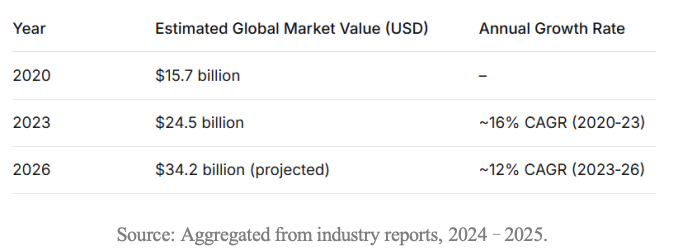
While the numbers remain impressive, the regulatory machinery built for e‑cigarettes is now largely mature. This has pushed authorities, advocacy groups, and industry to look ahead — and what they are looking at is the nicotine pouch.
The Rise of Nicotine Pouches
Nicotine pouches contain nicotine, flavorings, and plant‑based fibers, but no tobacco leaf. Products like ZYN, VELO, and On! have moved from niche Scandinavian alternatives to mainstream global brands. The category’s rapid expansion is captured starkly by market data.
Table 2: Nicotine Pouch Market Growth

Several factors are fueling this shift:
· Consumer demand for discreet, smoke‑free formats
· A perception (whether accurate or contested) of lower risk compared to smoking and even vaping
· Aggressive marketing and flavor innovation targeting adult nicotine users
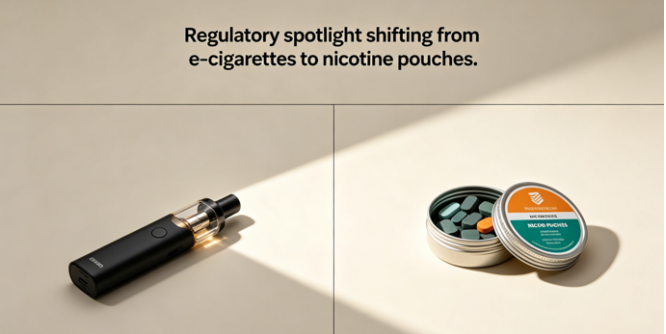
But as sales rise, the regulatory spotlight has followed.
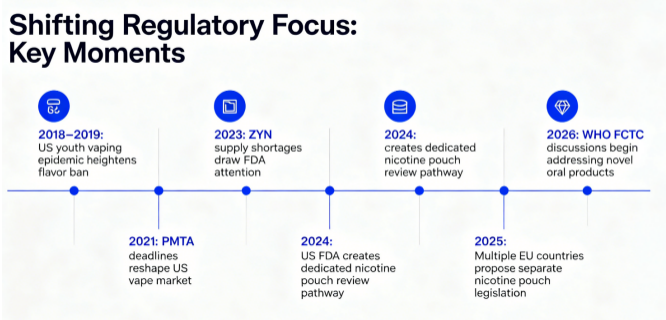
How the Regulatory Lens Is Changing
While e‑cigarette regulation focused heavily on inhalation risk, flavors, and youth initiation via vaping, the nicotine pouch debate is coalescing around a different set of concerns:
1.Nicotine concentration and absorption – pouches deliver nicotine without combustion, but high‑strength products (e.g., 12 mg or more) raise questions about dependence.
2.Youth appeal and discreet use – because pouches are used orally and are nearly invisible, schools and parents have flagged them as harder to detect than vaping.
3.Classification ambiguity – unlike e‑cigs, which fell under tobacco regulations due to containing tobacco‑derived nicotine, many pouches use synthetic nicotine, placing them in a grey zone in several jurisdictions.
This has prompted a wave of new regulatory actions that differ both in substance and speed compared with the e‑cigarette experience.
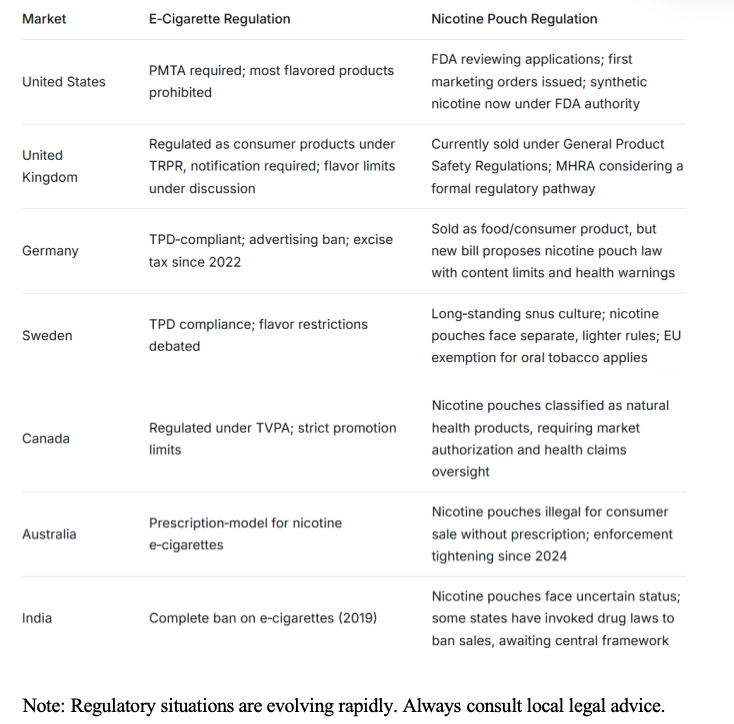
Table 3: Regulatory Snapshot — E‑Cigarettes vs. Nicotine Pouches (Selected Markets, 2025–2026)
What’s Driving the New Wave of Pouch Regulation
Three dynamics explain why nicotine pouches are becoming a priority for regulators worldwide:
· Market visibility: ZYN’s cultural moment in the United States (sparked in part by social media and even political discourse) drew the same kind of public attention that JUUL received in 2018. Visibility invites scrutiny.
· Nicotine product convergence: E‑cigarette, heated tobacco, and pouch manufacturers are often the same companies. Regulators now view nicotine regulation as an integrated challenge, no longer product‑specific.
· Precautionary bans: Some jurisdictions, observing the youth vaping experience, are moving preemptively to restrict nicotine pouches before widespread adoption, creating a patchwork that challenges international trade and compliance.
This shift is not just about adding new rules — it’s about rethinking how novel nicotine products are categorized. In several countries, dedicated “nicotine product” laws are being drafted that would cover pouches, synthetic nicotine liquids, and even nicotine gummies under one coherent framework.
Preparing for a Converged Regulatory Future
For businesses operating in this space, the lessons from e‑cigarettes are clear. The trajectory from minimal oversight to strict control can accelerate rapidly once public concern intensifies. Key steps to consider:
· Invest in science‑backed applications. Companies that proactively generate pharmacokinetic data, behavioral studies, and youth access prevention evidence will be better placed when regulators ask hard questions.
· Prepare for nicotine‑level caps. Several proposals in Europe and North America are coalescing around a maximum nicotine content per pouch (e.g., 10–12 mg), mirroring the earlier moves to cap e‑liquid nicotine concentrations.
· Align marketing with emerging norms. Discreetness and lifestyle branding are being treated as warning signals by regulators; messaging focused firmly on adult smokers switching away from cigarettes is likely to meet less resistance.
· Monitor the “synthetic nicotine” conversation. As synthetic nicotine becomes dominant, its regulation is being separated from tobacco laws in some countries and merged in others — a fluid landscape that demands constant horizon scanning.
Conclusion
The regulatory centre of gravity is moving. E‑cigarettes laid the groundwork, establishing a precedent that novel nicotine products must earn their place through stringent safety and public health assessments. Nicotine pouches are now navigating that same journey, but at an accelerated pace and with a distinctly different set of flashpoints.
For anyone tracking tobacco harm reduction, consumer trends, or compliance strategy, the shift from e‑cigarettes to nicotine pouches is not just a market story — it is the defining regulatory story of the next five years.