In the sprawling debate over New Generation Tobacco (NGT) products — e‑cigarettes, heated tobacco, nicotine pouches — no single regulatory lever has proven more contentious than flavor. Not nicotine caps. Not taxation. Not plain packaging. Flavor.
Why? Because flavor sits precisely at the collision point between the industry’s strongest commercial argument and the public health community’s gravest concern. Fruit medley, mint frost, candy crush, tropical mango — these descriptors are simultaneously the most effective tool for converting adult smokers away from cigarettes and, critics argue, the most powerful magnet for drawing in youth who would never have touched tobacco otherwise.
This article examines how three markets have wrestled with flavor regulation, why menthol occupies its own unique and politically charged category, and what the global trajectory tells us about the future of the flavor wars in the NGT space.

1. The Flavor Paradox: Why Flavors Exist in NGT Products
Flavors are not a cosmetic afterthought in NGT products. They are functionally central to the consumer experience — and to the public health dilemma.
Research consistently shows that adult smokers switching to e‑cigarettes or heated tobacco prefer non‑tobacco flavors, particularly fruit and menthol. A 2023 study published in Nicotine & Tobacco Research found that adult switchers using non‑tobacco flavors were 2.3 times more likely to have successfully quit smoking after one year compared to those using tobacco‑only flavors. The sensory dissociation from the taste of burning tobacco appears to reinforce the behavioral break from cigarettes.
At the same time, youth surveillance data repeatedly identifies flavors as the primary reason for experimentation. The US National Youth Tobacco Survey has consistently found that over 80% of youth who have ever used e‑cigarettes cited flavors as a key factor — with fruit, candy, and mint leading the list. Flavors mask the harshness of nicotine, making initiation easier for nicotine‑naïve users.
This is the flavor paradox in its sharpest form: the very characteristic that makes these NGT products effective for harm reduction among adults also makes them appealing to young people. Policymakers are left with an excruciating balancing act with no purely technical solution.
Table 1: Flavor Preferences — Adult Switchers vs. Youth Experimenters (Aggregated Survey Data, 2022–2025)
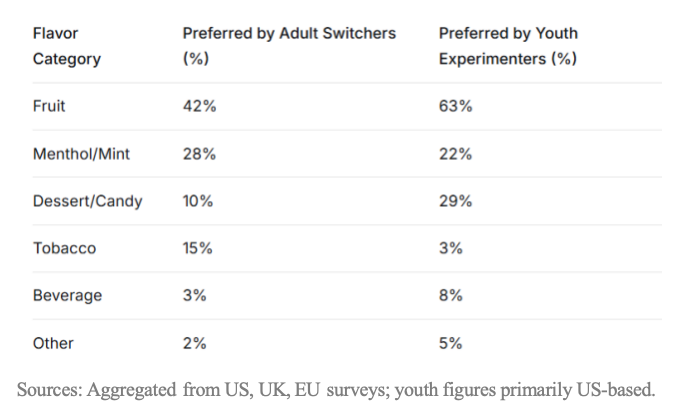
Note: Respondents could select multiple preferences; figures represent primary preference only.
The data captures the asymmetry: fruit flavors appeal broadly to both groups, but candy and dessert flavors skew dramatically toward youth, while tobacco flavors register almost exclusively among adults. This pattern has shaped NGT regulatory strategies worldwide, though with starkly different conclusions.
2. The United States: The Federal Flavor Ban and Its Unintended Consequences
The US experience with NGT flavor regulation is the most studied — and arguably the most cautionary — case study in the world.
In February 2020, the FDA finalized an enforcement policy effectively banning all characterizing flavors except menthol and tobacco in cartridge‑based e‑cigarettes. The policy responded to the youth vaping surge of 2018–2019, when JUUL’s mango, mint, and creme flavors had become cultural shorthand for a public health crisis. Disposable e‑cigarettes, which were not covered by the initial guidance, quickly filled the gap — flooding the market with fruit, candy, and hybrid flavors in devices that were cheaper, more accessible, and harder to regulate.
The result was a whack‑a‑mole dynamic. By 2023, disposables accounted for over 50% of the US e‑cigarette market, many in flavors explicitly designed to evade enforcement. The FDA has since issued marketing denial orders for millions of flavored products, but enforcement at the retail level remains inconsistent, and illicit imports continue to flow.
Table 2: Timeline of US Federal Flavor Actions — NGT Products (E‑Cigarettes and Nicotine Pouches)
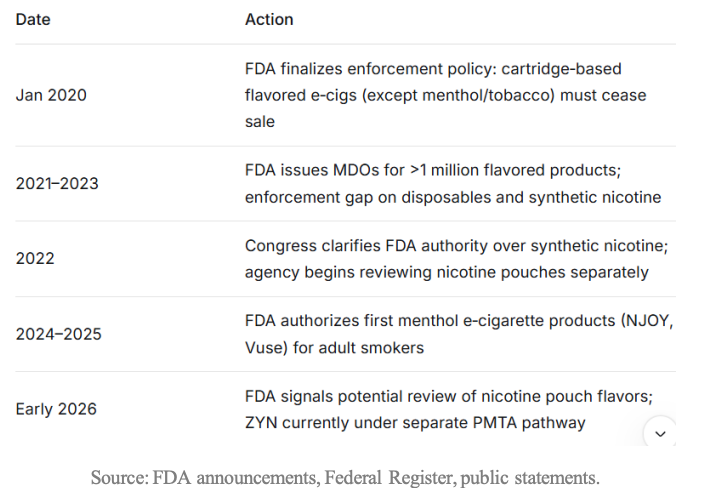
The menthol exception has been particularly politically fraught. The Biden administration’s proposed menthol cigarette ban, initially announced in 2021 and repeatedly delayed, became a proxy war over racial equity (menthol cigarettes are used disproportionately by Black smokers), public health, and political strategy. The debate has spilled into NGT regulation, complicating the FDA’s ability to draw a coherent flavor line.
[Image 2: Chart showing US e‑cigarette market share by product type, 2019–2025. Cartridge‑based share declines; disposable share surges. A callout box marks the 2020 flavor guidance enforcement date. Alt text: “US e‑cigarette market share shifting from cartridge‑based to disposable devices following the 2020 flavor guidance.”]
3. The European Union: TPD Flavor Bans and the Menthol Precedent
The European Union took a structurally different approach to NGT flavors, embedding restrictions in the Tobacco Products Directive (TPD) and subsequent delegated acts.
The key EU milestones are:
· 2016 TPD: Banned characterizing flavors in cigarettes and roll‑your‑own tobacco, but initially exempted e‑cigarettes and heated tobacco. Menthol cigarettes received a four‑year phase‑out, ending in May 2020.
· 2023 Delegated Act: Extended the characterizing flavor ban to heated tobacco products across all 27 Member States.
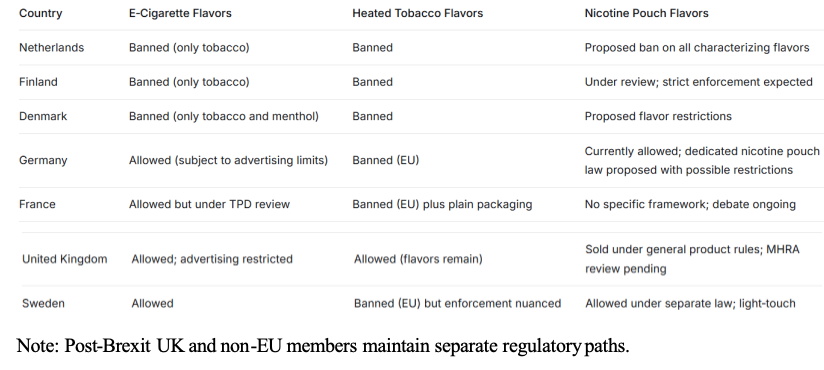
· Current TPD revision discussions (2025–2026): Strong momentum toward extending flavor restrictions to e‑cigarettes and potentially nicotine pouches, with several Member States (Netherlands, Finland, Denmark) already implementing national bans.
Europe’s regulatory architecture treats flavor not as a product‑by‑product question but as a horizontal principle: if an NGT product is consumed, characterizing flavors other than tobacco should not make it more palatable. This principle, once established for cigarettes, has proved remarkably expansive.
The menthol ban in cigarettes offers a real‑world data point. Studies published in 2023–2024 found that the ban led to a significant decrease in menthol cigarette sales across the EU, with some smokers switching to non‑menthol cigarettes and a smaller proportion migrating to e‑cigarettes or heated tobacco. The lesson for regulators was that flavor bans do reduce consumption of targeted products — but the net public health impact depends heavily on what consumers do instead.
Table 3: Flavor Regulation Status for NGT Products — Key European Markets (2026)
4. Asia: Japan and South Korea — Divergent NGT Flavor Strategies
Japan and South Korea, the two most significant Asian markets for heated tobacco — a key NGT category — have taken dramatically different positions on flavors, mirroring their broader regulatory philosophies.
Japan has no flavor ban for heated tobacco. Products from IQOS, glo, and Ploom are available in menthol, fruit‑infused menthol, and various aromatic blends. This permissive stance aligns with Japan’s broader treatment of HTPs as a distinct, lower‑risk NGT category and has contributed to the rapid displacement of cigarettes. Interestingly, despite the availability of flavored HTPs, youth smoking and HTP use in Japan have remained low by international standards — a pattern that challenges simple causal assumptions linking flavor availability to youth uptake in all cultural contexts.
South Korea, by contrast, banned characterizing flavors in both cigarettes and heated tobacco in 2020. The ban came after heated tobacco had already gained significant market share within the NGT landscape, and was justified primarily on youth protection grounds. Post‑ban surveys indicate a decline in heated tobacco’s growth rate, though the category has not collapsed. The Korean government has signaled its satisfaction with the policy and is considering extending it to nicotine pouches if the category grows.
5. The Menthol Exception: Why One NGT Flavor Stands Apart
Menthol occupies a unique regulatory and political space within NGT regulation, distinct from fruit, candy, or dessert flavors. Several factors contribute to its exceptionalism:
· Historical precedent: Menthol was a permitted cigarette flavor decades after most others were banned, creating an installed user base and a legitimate industry expectation of continued access.
· Racial equity dimensions: In the US and parts of Europe, menthol cigarettes are disproportionately marketed to and used by minority communities. Banning menthol has become entangled with broader debates about criminalization, enforcement, and community impact.
· Switching gateway argument: Industry argues — and some regulators have accepted — that menthol (and to some extent mint in nicotine pouches) serves a transitional function, helping adult smokers step away from combustible tobacco without the total sensory break that tobacco‑only NGT flavors require.
· The “adult flavor” narrative: Unlike gummy bear or cotton candy, menthol can be framed as a mature, non‑child‑appealing taste, though public health advocates vigorously dispute this characterization.
The FDA’s authorization of specific menthol e‑cigarette products in 2024–2025 marked a pivotal moment: the agency acknowledged, through its PMTA process, that menthol‑flavored NGT products could be “appropriate for the protection of public health” for adult smokers while being denied to most other flavors. This created a de facto two‑tier flavor system — menthol and tobacco on one side, everything else on the other — that is now being studied as a potential global model for NGT regulation.
6. Nicotine Pouches: The New NGT Flavor Frontier
As e‑cigarette and HTP flavor rules crystallize, nicotine pouches have emerged as the newest NGT flavor battlefield — and the one with the least settled regulatory framework.
ZYN, the market leader, is sold in flavors including citrus, cinnamon, coffee, wintergreen, and peppermint. The flavor profile is distinct from both e‑cigarettes (fewer candy/dessert options) and traditional oral tobacco (no tobacco taste). In the US, ZYN is currently under FDA review through the PMTA pathway; the agency has not yet made a definitive statement on NGT pouch flavors. In Europe, the absence of a harmonized NGT framework means national rules vary from permissive (Sweden) to restrictive (Netherlands, Finland) to legally ambiguous (Germany, until the pending bill).
The youth dimension is once again at the center. US data from the 2024 National Youth Tobacco Survey showed that while youth nicotine pouch use remains low relative to e‑cigarettes, it has grown. Flavored pouches account for the vast majority of youth experimentation. The narrative of a “ZYN epidemic” has already taken hold in some media and political circles, even if the absolute numbers remain a fraction of vaping.
Table 4: Nicotine Pouch Flavor Categories and Regulatory Sensitivity (NGT Context)
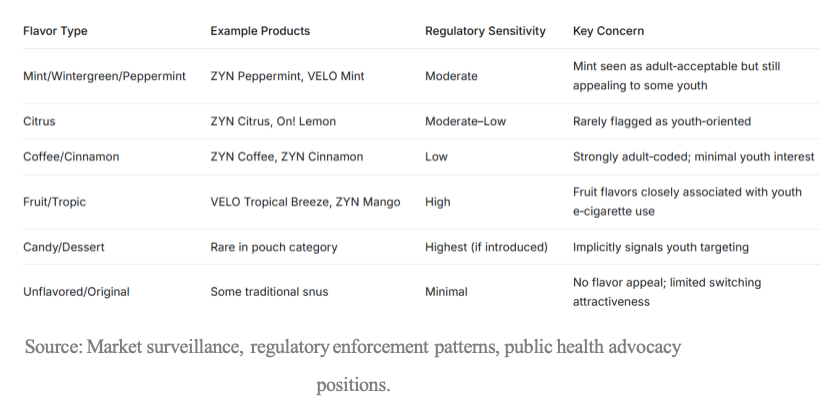
The flavor lines drawn for NGT pouches are likely to be shaped by the e‑cigarette experience. Regulators who witnessed the rapid flavor‑driven uptake of vaping among youth are preemptively nervous about pouches following the same trajectory — even if the product characteristics, usage patterns, and consumer demographics differ substantially.
Conclusion: The Unresolvable Tension in NGT Flavor Policy
The flavor wars will not end with a clean victory for either side. The underlying tension — between NGT products effective for adult switching and the same products being attractive to youth — is structural, not transitional. It is built into the very nature of nicotine consumption, where taste, pleasure, addiction, and risk are inseparably intertwined.
What is emerging instead is a global patchwork of NGT regulatory philosophies, each representing a different bet on how to manage the trade‑off. The US is moving toward a narrow authorization model: very few flavors, carefully vetted, primarily menthol and tobacco. Europe is consolidating around a horizontal ban on characterizing flavors across all NGT categories. Japan is betting that cultural context and existing social norms around youth access can contain the risks of a permissive NGT flavor market. And South Korea is doubling down on convergence — treating all NGT products the same, including in their flavor.
For the industry, the strategic implications are clear. Multi‑market NGT flavor strategies are becoming unsustainable. The companies best positioned for the next decade will be those that build their innovation pipelines around regulatory durability — NGT flavors that can demonstrate adult‑switching efficacy while withstanding youth‑access scrutiny — rather than around rapid flavor cycling that invites enforcement crackdowns.
For policymakers, the hard question remains: is the price of NGT flavors — in youth experimentation, in sustained nicotine dependence — worth the benefit in adult smoking cessation? The data can inform that calculus, but it cannot resolve it. The answer will continue to be political, cultural, and contested for years to come.