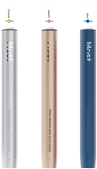
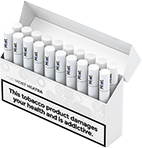
Few product categories embody the tension between harm reduction potential and regulatory precaution as starkly as heated tobacco products (HTPs). Devices like IQOS, glo, and Ploom heat processed tobacco to generate a nicotine aerosol without combustion. Proponents call them a breakthrough for adult smokers; critics see a new nicotine gateway wrapped in sleek hardware.
Yet the most striking feature of the HTP story is not the technology itself — it is the way three advanced, health-conscious economies have responded in completely different ways. Japan, South Korea, and the European Union share a desire to reduce smoking-related death. But their regulatory frameworks for heated tobacco could hardly diverge more. This article unpacks why.
1. Japan: The World’s Living Laboratory
Japan is the undisputed global leader in heated tobacco adoption. IQOS launched there in 2014 and, within a decade, HTPs captured roughly 30% of the country’s total tobacco market. Several factors made this possible:
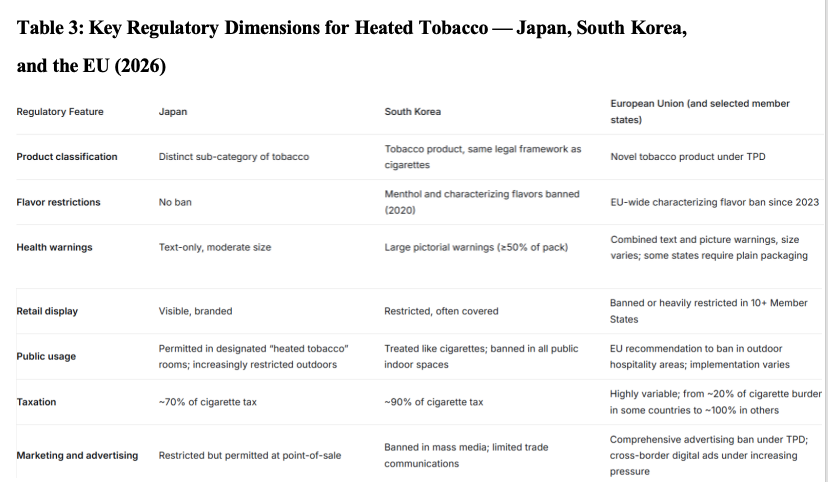
· Regulatory classification as a distinct tobacco product: Japan’s Tobacco Business Act treats heated tobacco as a separate sub-category of “manufactured tobacco,” not as a cigarette. This means HTPs are subject to milder tax rates, different health warnings, and fewer marketing restrictions than combustible cigarettes.
· No broad flavor ban: Unlike many Western markets, Japan did not prohibit menthol or characterizing flavors in heated tobacco. This preserved consumer switching appeal.
· Usage in designated smoking rooms: While public smoking is heavily restricted, many municipalities allow HTP use in dedicated “heated tobacco only” rooms, a regulatory carve-out that reinforced the perception of reduced risk.
The result was a real-world experiment in mass switching. Cigarette sales in Japan plummeted at an unprecedented pace — a decline several times faster than in countries where HTPs remained niche. Public health researchers continue to debate whether this represents a net gain, but the regulatory framework clearly enabled the shift.
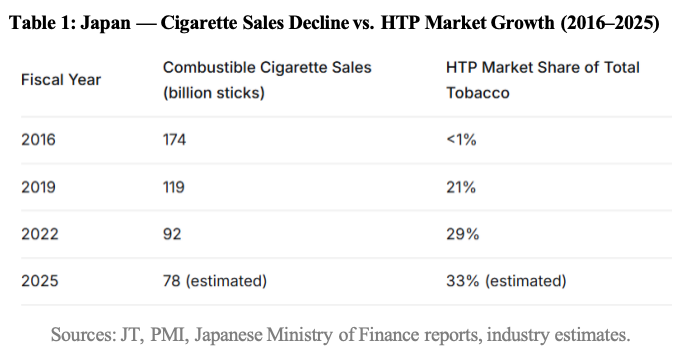
Japan’s path essentially treated HTPs as a harm reduction tool in all but name. The government’s financial incentive played a role too: the state owns a significant stake in Japan Tobacco, a major HTP manufacturer. This unique combination of public health pragmatism and economic interest is not easily replicated elsewhere.
2. South Korea: The Cautious Middle Ground
South Korea was the second major market to embrace heated tobacco, with IQOS launching in 2017 and an immediate uptake among Korean smokers. But the regulatory response diverged quickly from the Japanese model.
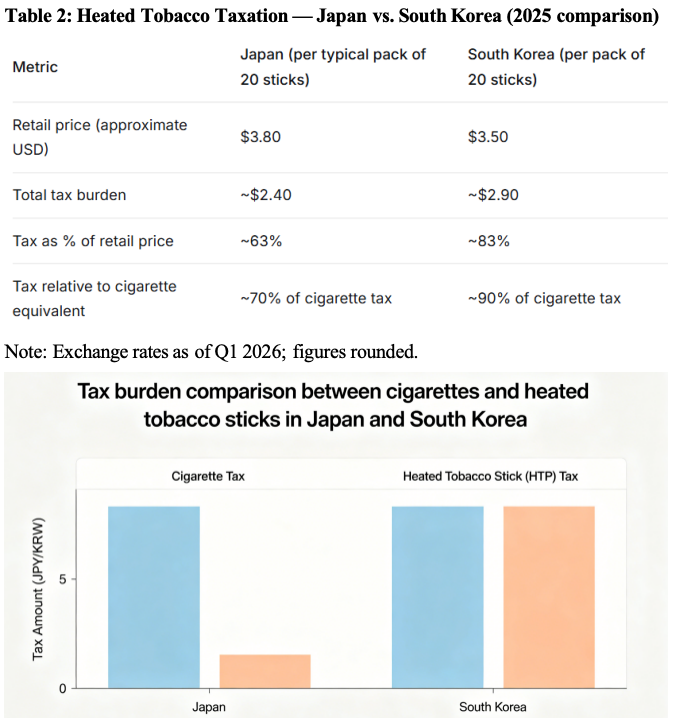
· Tax parity with cigarettes: Unlike Japan, South Korea applied a similar — though not identical — excise tax burden to HTPs. Today, the tax on a pack of heated tobacco sticks is roughly 90% that of a conventional cigarette pack, substantially narrowing the price advantage that drove early adoption.
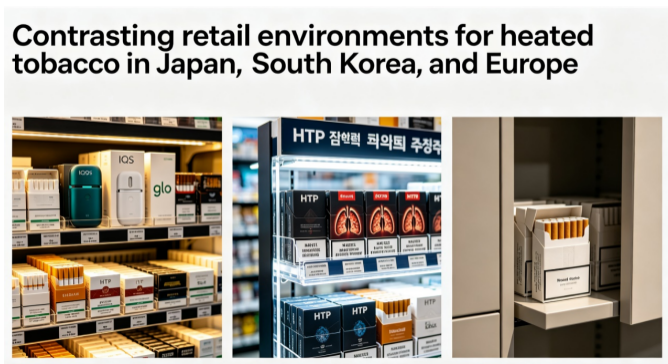
· Graphic health warnings: HTP packs in Korea must carry large, rotating pictorial health warnings, just like cigarettes. The images are stark — diseased lungs, surgical photographs — and leave no perceptual gap that could suggest lower risk.
· Retail display restrictions and advertising bans: Point-of-sale displays are restricted, and mass media advertising for HTPs is prohibited, placing them largely in the same marketing cage as combustibles.
· The EVALI shadow: The 2019 outbreak of e-cigarette or vaping product use-associated lung injury (EVALI) in the United States was linked to illicit THC cartridges, not heated tobacco. Nonetheless, the Korean government issued strong warnings against all novel nicotine products, and public trust in industry safety claims eroded. HTP growth stalled and has since been modest.
South Korea’s framework reflects a precautionary, convergence-oriented philosophy: if it looks and feels like tobacco, regulate it like tobacco. This has prevented the kind of rapid displacement of cigarettes seen in Japan, but it has also maintained a more stable tobacco control landscape.
3. Europe: The Fragmented Fortress
If Japan and South Korea represent two coherent — but opposite — national strategies, the European Union presents a kaleidoscope. Heated tobacco is regulated under the Tobacco Products Directive (TPD), which requires pre-market notification, ingredients reporting, and health warnings. However, the Directive leaves significant room for Member States to go further, and many have done so with enthusiasm.
Key fractures within Europe include:
· Flavor bans with early deadlines: The EU-wide ban on characterizing flavors for heated tobacco took effect in 2023, but several countries (including the Netherlands and Finland) moved earlier or extended the ban to cover additives beyond flavorings.
· Plain packaging and display bans: Countries like France, Norway, and Hungary have imposed standardized packaging and retail display bans on HTPs, visually equating them with cigarettes.
· Taxation disparity: While an EU directive on excise duties for novel tobacco products exists, tax rates vary wildly. Estonia levies a heavy excise on heated tobacco, while some Southern European countries maintain notably lower rates — leading to cross-border purchasing and a fragmented single market.
· Usage in public places: The EU’s recommendation on smoke-free environments, updated in 2024, calls on Member States to extend smoking bans to heated tobacco in outdoor and semi-outdoor areas. Implementation is uneven, with Ireland and Sweden adopting strict rules while others lag.
The European approach is shaped by the precautionary principle — assume risk until proven otherwise — and by a desire to avoid repeating the perceived regulatory failure around e-cigarettes. Consequently, the European HTP market, while growing, is a patchwork of divergent compliance requirements that challenge pan-European brand strategies.
Why the Three Paths Diverged So Dramatically
The regulatory schism cannot be explained by science alone — the chemistry and toxicology of heated tobacco aerosol are broadly similar wherever it is studied. Instead, five forces drove Japan, South Korea, and Europe apart:
· Preexisting smoking cultures: Japan’s high smoking rate among men and strong communal smoking etiquette made HTPs a socially smoother switch. Europe’s already declining smoking rates and powerful anti-tobacco NGOs created a more hostile starting environment.
· Institutional and fiscal incentives: Japan’s state ownership in Japan Tobacco created a direct interest in a successful domestic reduced-risk product. South Korea’s national health insurance system, facing spiraling costs, was more cautious about anything that might sustain nicotine addiction. The EU’s decision-making structure — requiring consensus among 27 members — naturally trends toward the most restrictive common denominator.
· The timing of regulatory action: Japan regulated HTPs early, before the global backlash against novel nicotine products took full force. Europe moved later, after the EVALI crisis and JUUL youth epidemic had soured policymakers on industry promises. South Korea found itself in the middle, with an existing but amendable tobacco law.
· The role of courts and challenges: In the EU, pro-vaping and pro-HTP legal challenges have repeatedly pushed back against extreme bans, creating a dynamic, litigation-influenced landscape. Japan’s regulatory environment is less adversarial. Korea’s constitutional court has largely deferred to health authorities.
· Harm reduction ideology: At its core, the divide reflects a fundamental disagreement: can a product that sustains nicotine addiction ever be part of a public health solution? Japan’s framework implicitly answers “yes.” The EU’s framework leans strongly toward “no.” South Korea has tried — uneasily — to occupy the middle.
Conclusion: A Convergence Unlikely
Will these three regulatory worlds eventually align? The forces that pushed them apart remain firmly in place. Japan shows no appetite to radically raise HTP taxes or ban flavors; the public health community is divided but the political cost of disrupting a popular product category is high. The EU, with the next Tobacco Products Directive revision in sight, is more likely to tighten rules further than to liberalize them. And South Korea, ever the pragmatist, will likely continue to fine-tune its framework within the tobacco-control mainstream rather than pivot toward either extreme.
For manufacturers and compliance teams, the lesson is clear: there will be no single global HTP rulebook. The path to market in Tokyo runs through a completely different gate than in Seoul or Brussels. Success in this category belongs to those who build not a single global product — but a globally adaptable compliance muscle, capable of navigating the deep and enduring divisions of the heated tobacco world.