1.Current State of Global Pod-system E-Cigarette Industry Cooperation
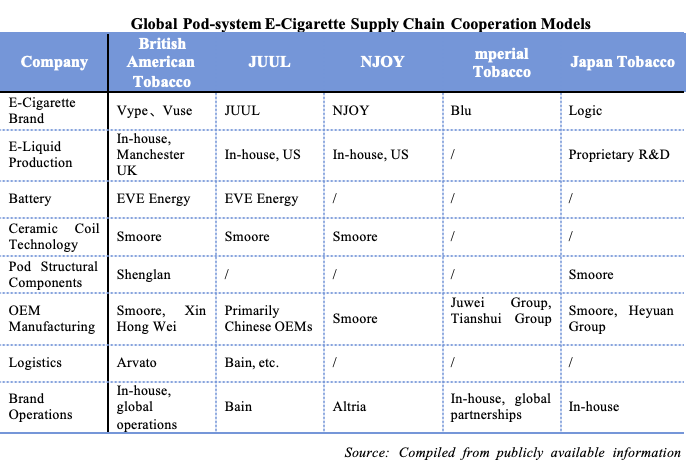
Looking at the major global Pod-system e-cigarette supply chain cooperation models, the global e-cigarette industry has evolved over many years with increasingly clear division of labor. The e-cigarette industry chain encompasses raw material supply, manufacturing, and brand operations. Among the major global Pod-system e-cigarette companies — including British American Tobacco, JUUL, NJOY, and Japan Tobacco — e-liquid production is primarily handled in-house. China, with the world's most comprehensive electronics industry base, has emerged as a global hub for e-cigarette manufacturing, covering equipment and OEM assembly. International e-cigarette brands typically choose established manufacturers such as Smoore, Heyuan, and Tianshui for product manufacturing and OEM services. After OEM production is completed, e-cigarette brands handle their own brand operations, channel development, and product sales.
2.Global Pod-system E-Cigarette Industry Cooperation Trends
2.1 Regulation Steering Industry Collaboration Directions
For an extended period, disposable e-cigarettes were more widely promoted globally as they were more favored by consumers. Consequently, product collaborations among e-cigarette manufacturers were primarily concentrated on disposable e-cigarettes. Over the past two years, restrictions on disposable e-cigarettes have intensified globally, with countries including France, the United Kingdom, Australia, New Zealand, and Canada planning to ban the sale of disposable e-cigarettes entirely. As regulatory policies shift, Pod-system e-cigarettes and other product categories have emerged as the development direction guided by regulatory changes. Therefore, the focus of global e-cigarette industry collaboration will further shift toward the Pod-system e-cigarette segment.
2.2 Localization of International Brands
In the internationalization process of e-cigarette companies, consumers in different regions exhibit distinct consumption habits and product preferences, making localization increasingly important. Korean e-cigarette brands have adopted cross-border cooperation and localization strategies in their international expansion. Chinese e-cigarette brand RELX has driven its brand through partnerships with overseas distributors. Additionally, e-cigarette brands are deepening their integration into local markets through joint ventures or licensing agreements with local enterprises. Smoore has built a "China + Indonesia + Europe + North America" four-pole supply chain system to reduce reliance on any single region. Its East Java factory in Indonesia serves as a Southeast Asian hub, primarily manufacturing BAT's Vuse Alto Pods series for the ASEAN and Australian markets. The Hungary factory serves the European market with a localized R&D center focusing on products compliant with EU TPD standards. The California factory focuses on FDA-approved products to meet North American compliance requirements.
2.3 Strengthened International Industry Collaboration
In the global collaboration of the Pod-system e-cigarette industry chain, counterfeit and compatible products have proliferated, exemplified by the rise of RELX compatible pods in Southeast Asian markets and ELFBAR compatible products in the European market. This has prompted Pod-system e-cigarette brands to strengthen industrial collaboration in intellectual property protection and technical cooperation. For instance, RELX has partnered with police in Southeast Asia on anti-counterfeiting operations, while ELFBAR has developed anti-compatibility technologies such as chip authentication and unique interface designs. For example, ELFBAR's recyclable structural design increases disassembly difficulty. In the short term, counterfeit and compatible products may erode brand share through lower prices. In the long term, brands that enhance intellectual property protection and structural technology upgrades will strengthen consumer mindshare, gain valuable international market experience, and ultimately capture larger global market share.
2.4 Enhanced Social/Entertainment Attributes of E-Cigarette Products
With the continuous advancement of artificial intelligence, the Internet of Things, and smart hardware, innovative products such as full-screen e-cigarettes and smart e-cigarettes are emerging. More e-cigarette companies are integrating smart hardware and software functions into their devices, transcending the traditional tobacco product category to become smart products with social and entertainment attributes. In this process, collaboration between e-cigarette companies and smart hardware enterprises will increase, particularly in the growing demand for smart chips, sensors, and new display panels in e-cigarette products.