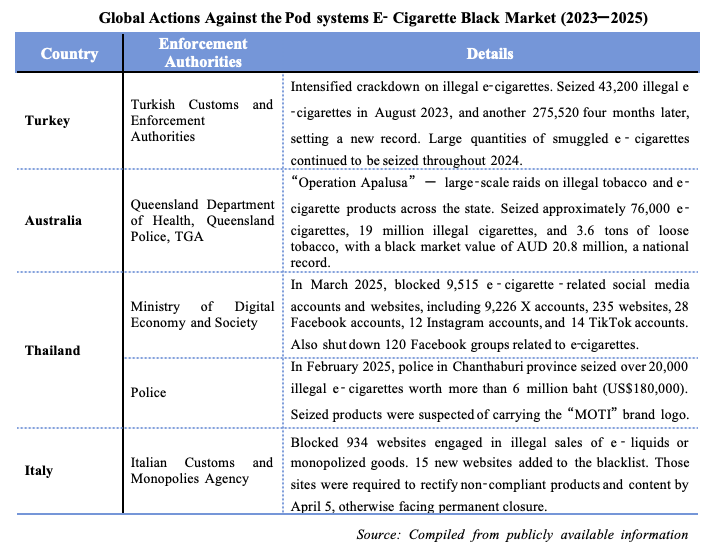
1.Increasing Crackdown on the Global Black Market
Many countries around the world have implemented total or partial bans on e‑cigarettes, including bans on flavored e‑cigarettes, import bans, and bans on use in public places. Due to the large demand for e‑cigarettes, the strong appeal of non‑tobacco flavors to adolescents and young adults, and the high enforcement costs associated with regulating multiple links in the e‑cigarette industry, a global black market has emerged. Since Singapore introduced its strict e‑cigarette ban in 2018, illegal trade has remained very active. Data from Singapore’s Ministry of Health shows that the number of people arrested for possessing or using e‑cigarettes reached 7,838 in 2023, a 60% increase from 4,916 in 2022.
On one hand, black market e‑cigarettes often lack regulation, leading to inconsistent product quality and potentially containing high concentrations of nicotine or other harmful substances such as vitamin E acetate. According to CannaSafe testing, all black market products failed the CA testing requirements for regulated products, and nearly all black market e‑cigarettes contained large amounts of vitamin E acetate. On the other hand, the rise of the black market harms existing or potential tax revenues and squeezes the legitimate space for compliant e‑cigarette companies. It is foreseeable that combating the e‑cigarette black market will remain an important regulatory focus for Pod systems e‑cigarettes in the years ahead.
2.Systematic and Institutionalized Regulation
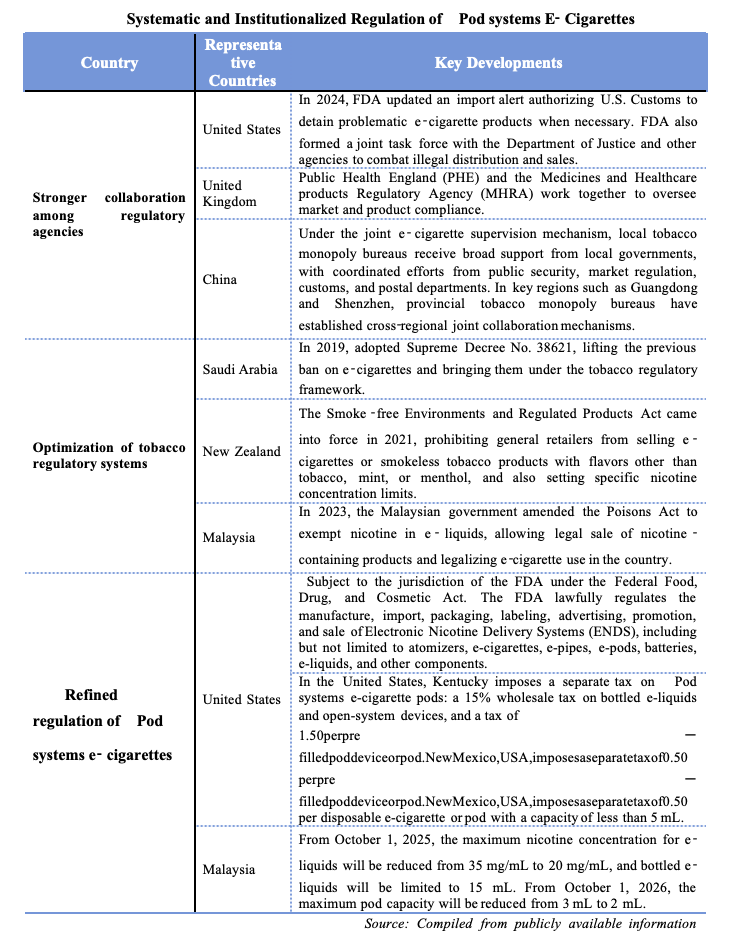
In the early 2000s, e‑cigarettes emerged, and regulators in most countries had limited understanding of this new type of tobacco product. Developed countries and regions such as the United States and the European Union had not yet introduced specific regulations for e‑cigarettes. In the 2010s, as e‑cigarettes became more popular, their safety and market impact attracted global attention. In 2014, the EU adopted the Tobacco Products Directive (TPD), which set rules on e‑cigarette composition, packaging, labeling, and advertising. In 2016, the US FDA’s Center for Tobacco Products extended its regulatory authority to e‑cigarettes.
With the increasing adoption of e‑cigarettes and the emergence of next‑generation products such as Pod systems devices, regulations have become more detailed. Specific regulations for Pod systems e‑cigarettes have emerged, covering aspects such as nicotine output stability, nicotine concentration in pods, pod ingredients, disposable e‑cigarette bans, and taxation.
Global e‑cigarette regulation has moved step by step from a lack of oversight toward systematic and institutionalized governance. In this process, collaboration between regulatory agencies has strengthened, tobacco control systems have been optimized, and specific rules for the Pod systems segment have emerged.
3.Stricter Industry Policies and Regulations
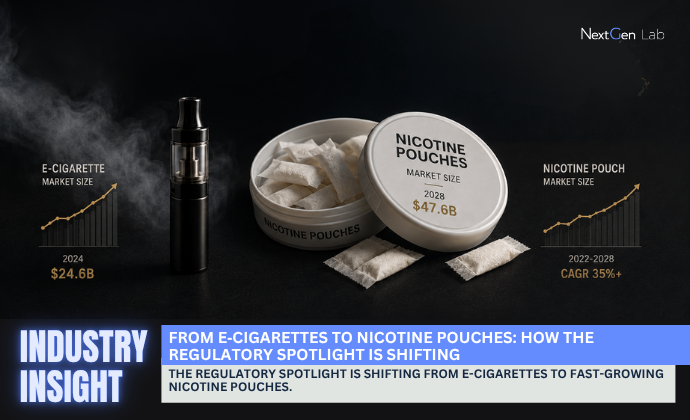
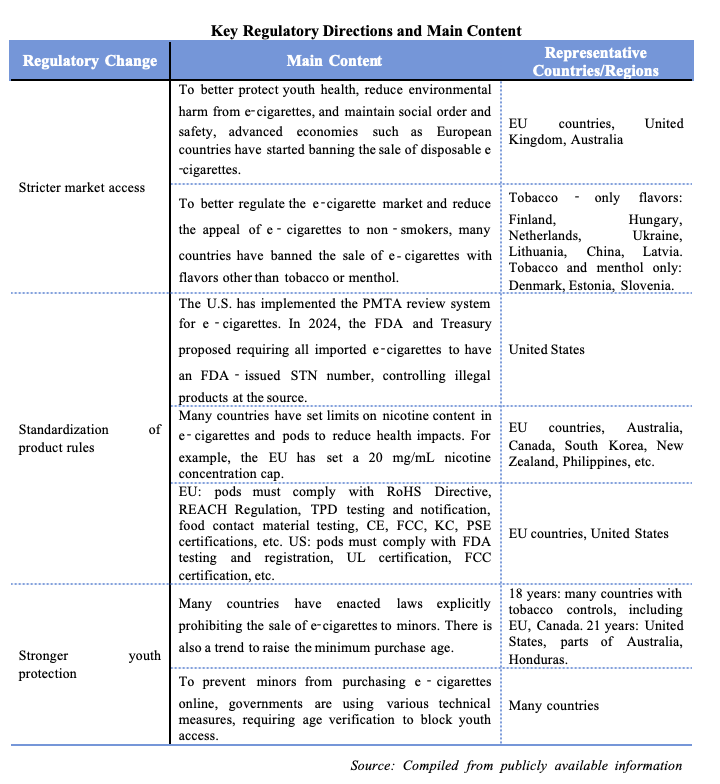
Currently, looking at regulatory changes in major countries and regions, global e‑cigarette regulation is tightening further, particularly in areas such as market access, product standards, and youth protection. During this process, Pod systems e‑cigarette companies face challenges from registration and production restrictions that impact product innovation and sales. At the same time, the increase in disposable e‑cigarette bans is creating more market space for Pod systems products. Thus, tighter regulation brings both challenges and opportunities for the Pod systems e‑cigarette industry.
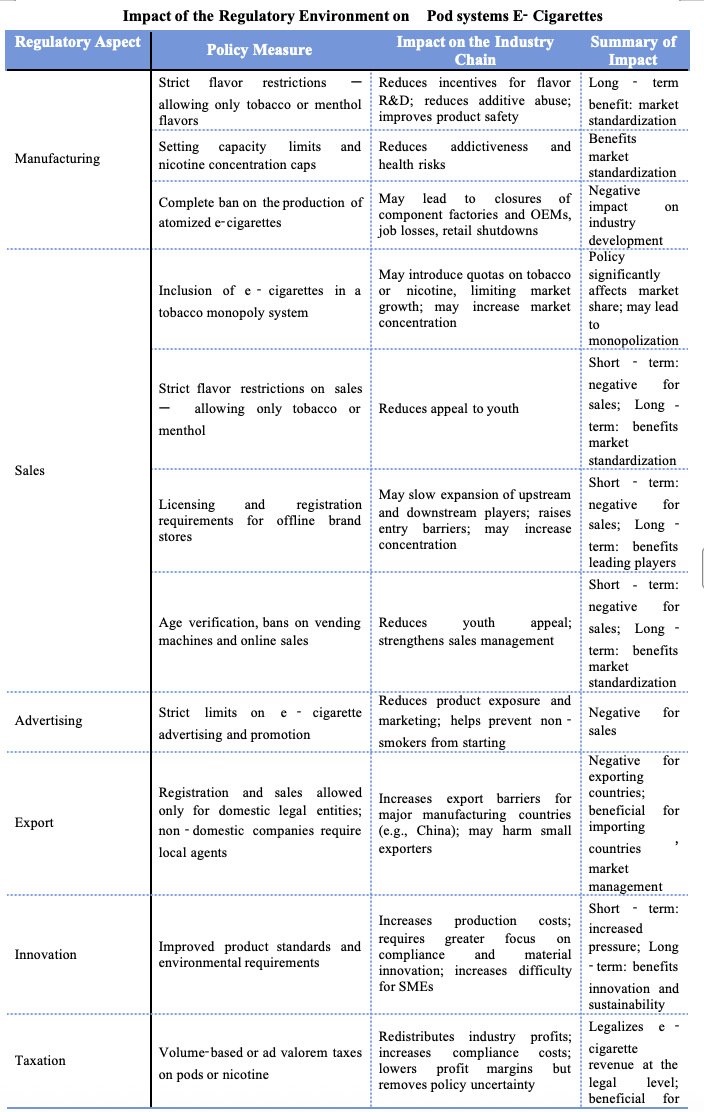
4.Impact of the Regulatory Environment on Pod systems E‑Cigarettes
The regulatory environment affects the Pod systems e‑cigarette industry in many ways, including manufacturing, sales, advertising, export, and innovation. Because e‑cigarettes are in a heavily regulated environment, different regulatory intensities can have significantly different impacts on the development of the industry in different countries.