1. Key Concepts in Pod System Vapes
1.1 Novel Tobacco Products (NGP)
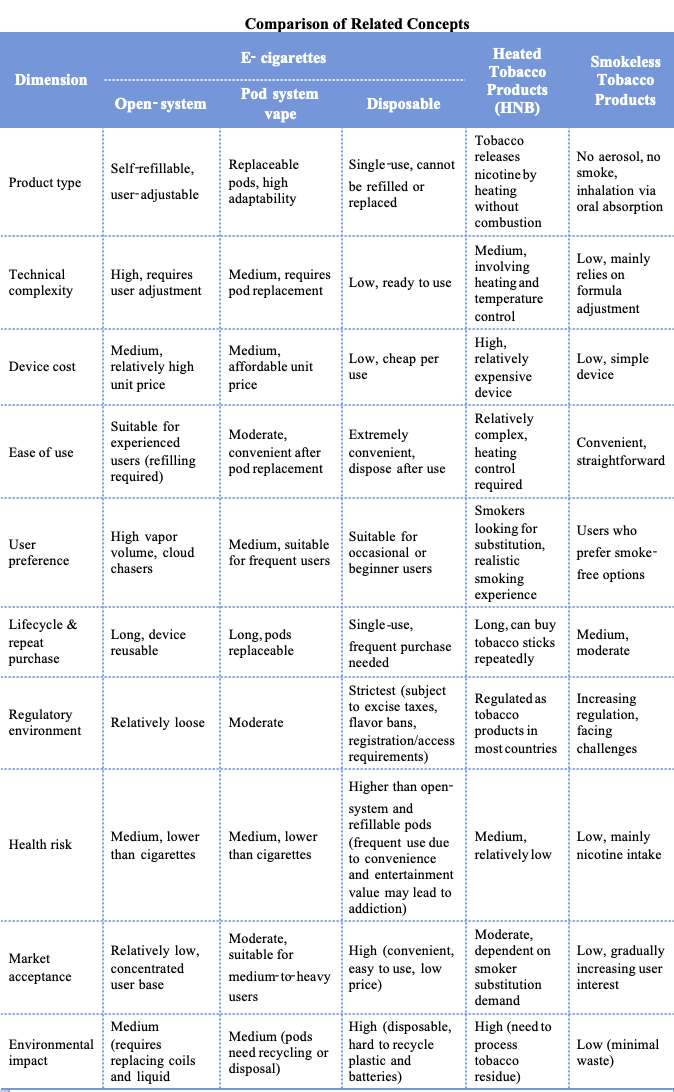
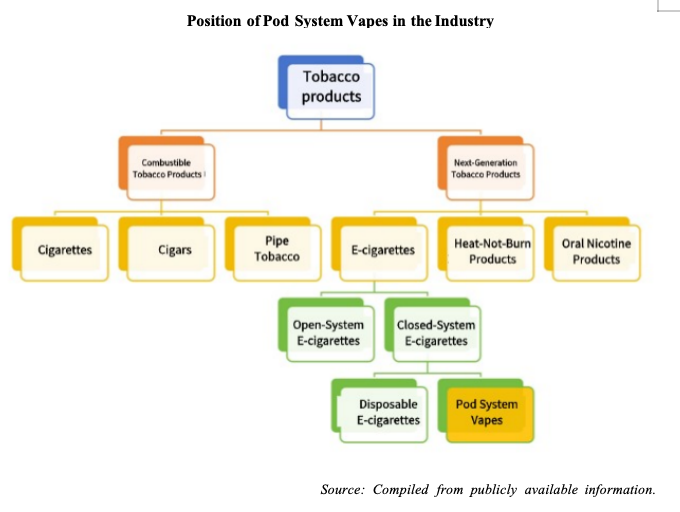
Novel tobacco products (New Generation Products, NGP) are a category of reduced‑risk tobacco products distinct from traditional combustible cigarettes. Their core feature is the release of nicotine or simulation of the smoking experience through non‑combustible means, thereby reducing harmful substances generated by combustion. According to the World Health Organization (WHO) and industry consensus, NGPs are mainly divided into three major categories:
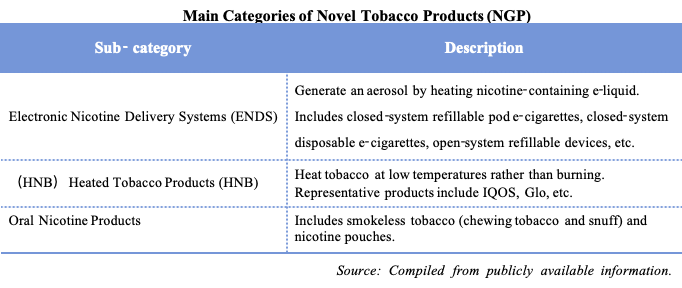
From a product‑type perspective, open‑system e‑cigarettes attract users seeking personalized experiences due to their high adjustability and strong vapor production. However, their complex structure, high usage threshold, and frequent maintenance prevent wide penetration in the mass market. Among closed‑system e‑cigarettes, refillable pod systems gain an advantage through convenience, but taxes and technical issues limit their proliferation. Disposable e‑cigarettes were once favored for their low cost, but higher taxes and tighter ingredient regulations have caused market contraction. Heated tobacco products and smokeless tobacco products offer health and environmental benefits but have lower market acceptance.

1.2 Electronic Nicotine Delivery Systems (ENDS)
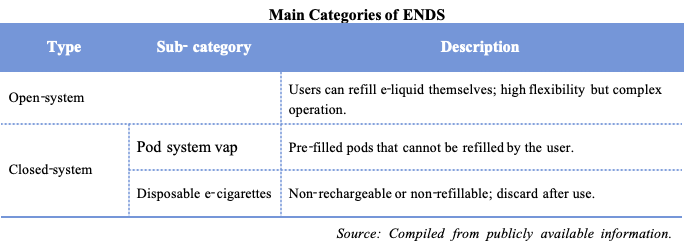
Electronic Nicotine Delivery Systems (ENDS) are a core branch of NGP. Their working principle is to use a battery to drive an atomizer coil to heat e‑liquid, converting liquid nicotine into an inhalable aerosol. Their key advantages include precise control of nicotine concentration, diverse flavors (e.g., fruit, mint), and better portability than traditional tobacco products. Based on product form and technical differences, ENDS can be divided into the following types:
1.3 Pod System Vape
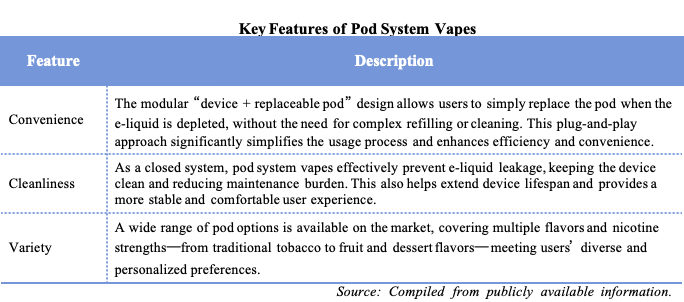
A pod system vape is a closed-system electronic cigarette that adopts a modular “device + replaceable pod” structure. Its core design philosophy is to deliver an efficient and user-friendly experience through a convenient pod replacement mechanism.
Technically, each pod integrates a built-in coil and e-liquid reservoir, and connects to the device via magnetic or twist-lock mechanisms, while the device itself supplies power through an internal battery.
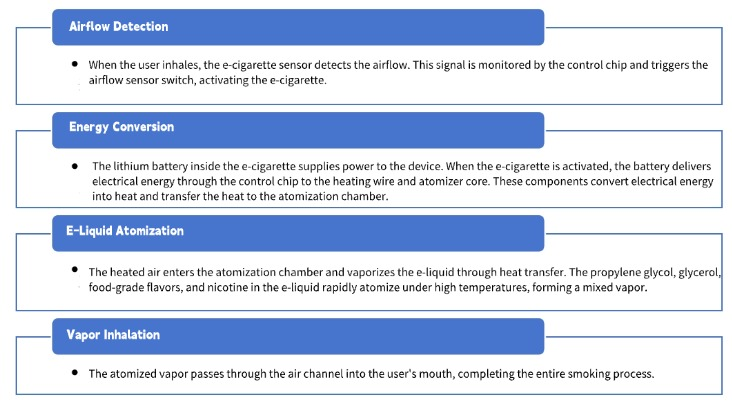
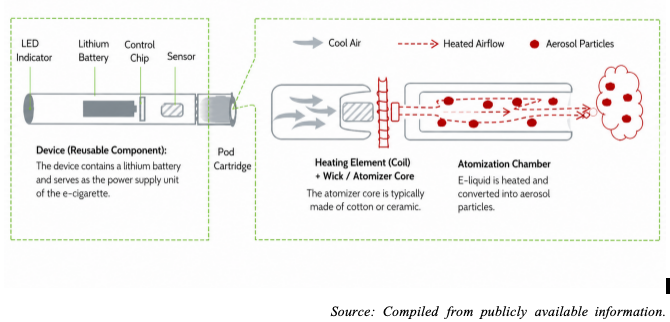
Key features of pod system vapes include plug-and-play convenience, flexibility in switching between multiple flavors, and compliance with regional regulations (such as the EU TPD). In the market, leading brands include VUSE, JUUL, NJOY, and SKE.
2. Industry Positioning of Pod System Vapes
As a subcategory of new tobacco products, pod system vapes fall under closed-system e-cigarettes within the broader e-cigarette category. They have emerged as a product form driven by consumer demand for portability, reusability, and cost efficiency.
Compared with disposable e-cigarettes, pod systems separate the device and pod structure, enhancing cost-effectiveness and environmental sustainability while maintaining ease of use.
Positioned within medium-to-high frequency usage scenarios, pod system vapes align with brand strategies focused on user retention and long-term repurchase rates. They have gradually evolved into a core product form bridging entry-level products and high-end customizable devices, representing a key direction in product segmentation and user stratification within the e-cigarette industry.
3. Notes on This Report
3.1 Scope Definition
In this report, “e-cigarettes” refer to Electronic Nicotine Delivery Systems (ENDS) as described in the overview. Pod system vapes are defined as an important subcategory of closed-system e-cigarettes within the broader industry.
Their core characteristic is the modular “device + replaceable pod” structure, offering convenience and reusability while meeting consumer needs for cost efficiency, portability, and user experience in medium-to-high frequency usage scenarios. They are positioned as a distinct product category separate from disposable and open-system e-cigarettes.
3. 2 Data Sources
3. 2.1 Data Sources Overview
The core data in this report is sourced from Euromonitor International and Qianzhan Industry Research Institute. The statistical scope focuses on retail market data, reflecting actual consumer purchase prices rather than production or wholesale prices. All monetary values are presented in USD.
Consumer behavior and preference data are derived from multiple authoritative sources, including:
·U.S. adult e-cigarette usage data from the CDC
·Global and UK flavor and device preference studies from Plxsur and ASH
·Research on media usage and vaping behavior in the UK from Thorax
·Survey data on New Zealand users from the Acvoda Foundation
3.2.2 Data Collection Methodology
Euromonitor’s data collection covers four key dimensions:
·A global network of over 2 million retail outlets, capturing POS sales data and inventory changes
·Integration of annual reports from leading companies such as Philip Morris International, British American Tobacco, and RELX, along with third-party research
·Access to official import/export statistics from national tobacco authorities, tax agencies, and customs systems
·Consumer surveys exceeding 5 million samples annually, covering flavor preferences, brand loyalty, usage frequency, and other key indicators
3.3 Global Statistical Scope
When calculating global tobacco market data, China is excluded due to its unique regulatory framework for new tobacco products, which differs significantly from other markets.
Since the implementation of stricter e-cigarette regulations in 2022, China’s market has experienced increased volatility. Therefore, it is excluded to ensure data comparability and analytical accuracy.
3.4 Exchange Rate Notes
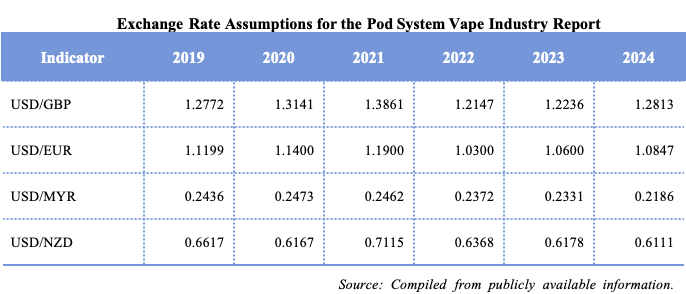
The annual average exchange rates of major currencies against the USD from 2019 to 2024 are as follows: